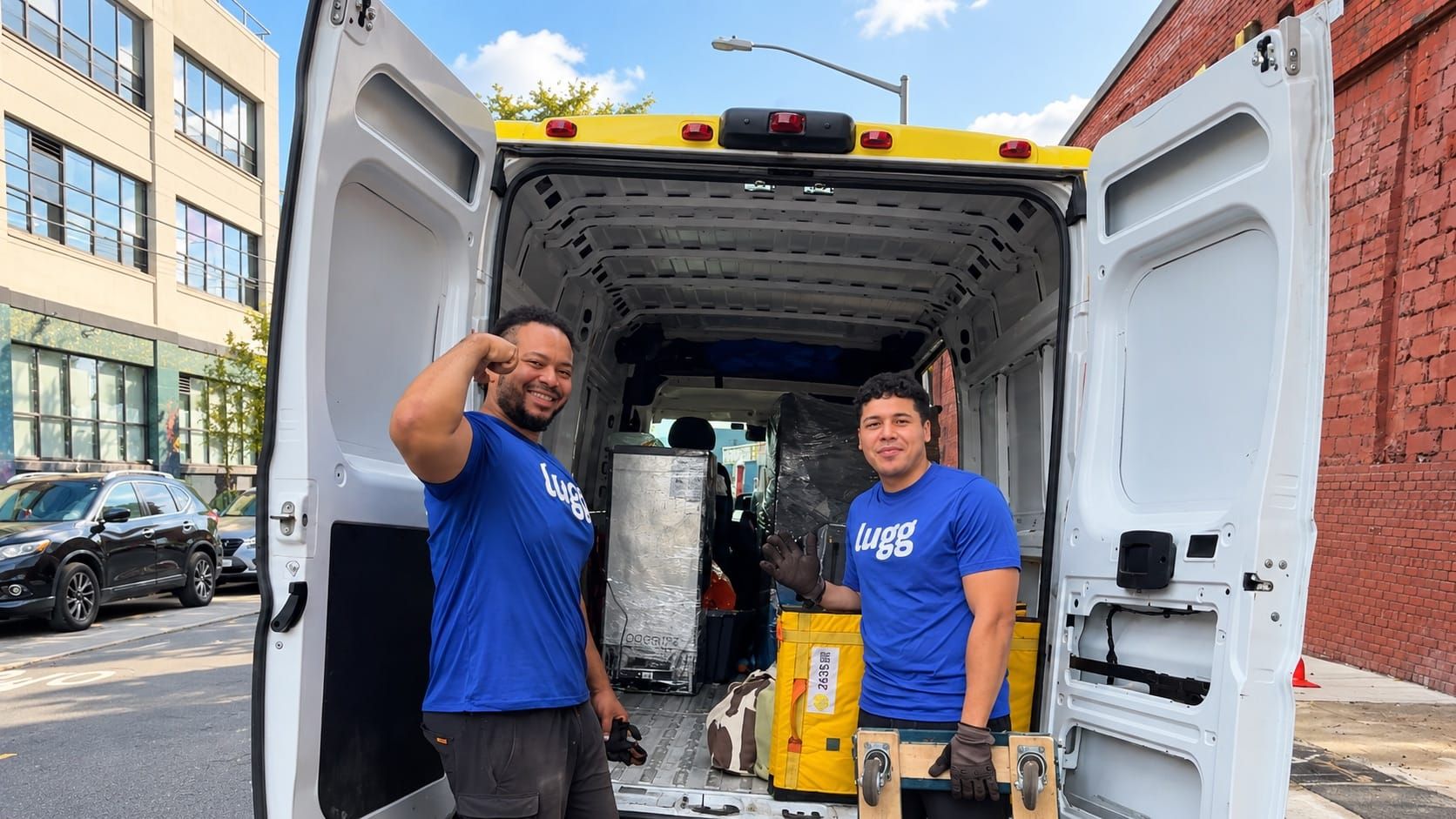
Weekend jobs near me: how to earn on Saturday and Sunday only
Weekend-only work doesn’t have to mean someone else’s schedule. Here’s how Lugg fits around Saturdays and Sundays, what each role pays, and how to start.

Most weekend jobs come with somebody else's schedule already attached. You take the Saturday shift because it's the one you were given, then spend the rest of the week fitting your life around it.
Lugg is different. If Saturdays and Sundays are the days you have, you can sign up to do moving work on those days and leave weekdays alone.
There are two ways in, and they pay differently. Take the one that matches what you own. Weekend-only demand varies by market; the sign-up flow is where you can see whether Lugg is available near you and which role fits.
| Moving helper | Driver | |
|---|---|---|
| What you need | A smartphone and the ability to lift up to 125 lbs. No vehicle. | A qualifying pickup, cargo van, XL van or box truck, insurance in your own name, and basic moving equipment |
| Minimum age | 18+ | 21+ |
| Pay | $18/hr avg + tips | $28–$47/hr avg + tips, by vehicle |
| CDL | Not required | Not required |
| Start here | Moving helper | Driver roles and vehicle specs |
Can you work only Saturdays and Sundays with Lugg?
Yes, Luggers are independent contractors who choose which slots to take, so you can work a Saturday, a Sunday, both, or skip a weekend without a requirement to work weekdays or every weekend.
Working weekends around a full-time job
With Lugg, there's no weekly minimum and no schedule that resets against you when you skip a month. Skip a weekend and there's nothing to make up, where a standing Saturday commitment somewhere else has to be negotiated out of every time your life needs the day back.
One Lugger in San Diego chose the platform for "the flexibility with flight school and the instant payout at night", a fixed weekday commitment that could not move, with the work arranged around it.
Earnings varies, a busy Saturday in a dense market is a very different day from a quiet one, and two weekends is not enough to know which one you live in. Nobody should plan fixed monthly bills around a two-day-a-week gig before they've worked a few and watched what their own market does.
The same slot-based model can work on weekday evenings if you want more than two days.
Is Saturday or Sunday busier?
Saturday is Lugg's busiest day. Lugg booking data from September 2025 through August 2026 shows about 20% more Lugger work hours on Saturday than Sunday.
Friday belongs in this conversation too. It ran at 15.9%, within a rounding error of Saturday, because plenty of moves get timed to land before a weekend rather than during it. If your weekday job finishes early on a Friday, a Friday evening plus a full Saturday is the densest two days available.
Can you plan a weekend, or do you wait for work to appear?
You can plan it. Roughly 5 in 6 weekend moves are booked ahead by the customer. Most of a Saturday's work is on the board days before the Saturday itself.
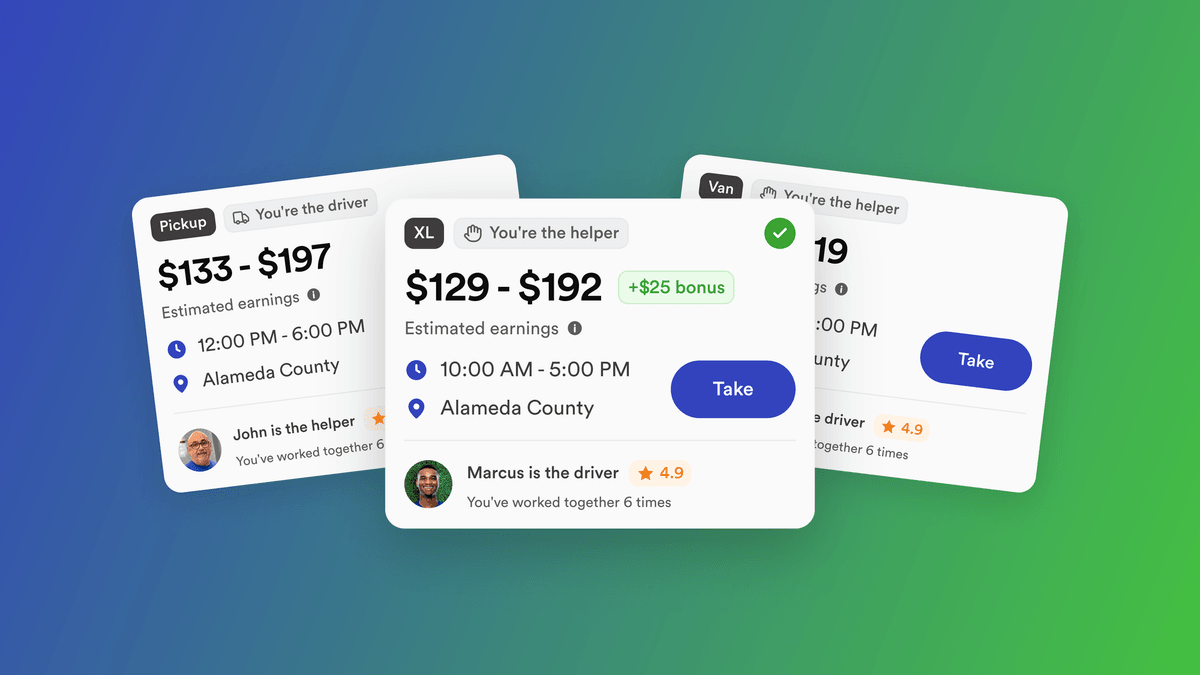
A rideshare or delivery app can make a Saturday a wait-and-see day: you go online and wait for requests. With Lugg, you claim the weekend slots you are free to work. Once you are online for a slot, Lugg dispatches moves right to your crew.
Claiming slots earlier in the week gets you the pick of what's on the board, and the Saturdays that fill first are the ones in the densest parts of a market.
What do weekend jobs near me actually pay?
Pay splits by role, so read the figure for the role you'd actually take.
If you don't have a qualifying vehicle, you can start as a moving helper. Moving helpers earn $18/hr on average, plus tips. You work alongside the driver: keeping the customer updated, and handling the lifting and loading. Nothing to bring but a phone, and nothing to buy, insure or maintain. The full walkthrough is in how to become a Lugg helper.
If you already own a truck or a van, you drive. Driver pay runs from $28/hr average for a pickup up to $47/hr average for Box+, all plus tips, and the rate tracks the vehicle: pickup $28, cargo van $32, XL van $37, box truck $42, Box+ $47. Mileage and tolls are reimbursed for drivers: mileage for qualifying zone miles at a set rate that varies by truck type, plus most required tolls. Drive for Lugg covers the vehicle requirements in detail.
For current role requirements, compare pickup truck driver, cargo van driver, and box truck driver.
Every figure above is an hourly average, not a guarantee. What you actually clear varies with how busy your market is that weekend and how many slots you pick up. Tips are paid per move, split evenly between the driver and the helper, and Lugg takes no cut of them. Pay lands the same day you work.
What is the work, actually?
The work is physical and local, and it's short jobs rather than long routes. A Lugg is a customer moving something: a couch to a new apartment, a mattress out of a third-floor walk-up, a store purchase that won't fit in their car. You arrive inside the window, load, drive, unload, and you're done. Lugg takes items up to 250 lbs, and no one person is expected to carry more than 125 lbs of that.
Three things to know before you start. There's no résumé. A background check is required and paid for by the Lugger, taken out of future earnings rather than charged upfront. And you're an independent contractor, so you're running your own small operation: you track your own miles and set aside your own taxes.
How do I start working weekends this week?
Sign-up is a short form. The required background check determines when you can begin, so start it before the weekend you hope to work.
1: Sign up and pick your role
Go to the sign-up form and choose moving helper or driver. It's about five fields (name, date of birth, the role you want) and takes roughly two minutes. Pick helper if you don't have a qualifying vehicle; you can always add one later.
2: Clear the background check
A background check is required for every Lugger, and you pay for it out of future earnings rather than upfront. This is the step that sets your timeline, so start it the day you sign up rather than the day before the weekend you want to work.
3: Get your equipment together if you're driving
Drivers bring their own blankets, ratchet straps, a dolly and stretch wrap, and pickup drivers add a tarp. It's a small one-off cost that pays for itself quickly, and it's the thing most likely to hold up a first weekend if you leave it to Friday night. Helpers skip this step.
4: Pick your first weekend slots
Once you're activated, you choose when you work. Claim a Saturday, and add Friday evening if you want the density. You don't have to work every week, or any week. Once you've claimed a slot, you show up for it because there's a customer waiting at the other end.
Picking up your first Saturday
If you have a phone and your Saturdays are open, the Moving Helper path is the lower-bar way in: a smartphone, the ability to lift, and the required background check paid from future earnings. If you have a pickup, a van or a box truck sitting unused from Friday night to Monday morning, the driver path pays more and you've already done the hard part.
Sign up to work with Lugg. The form takes about two minutes, and it will show whether Lugg is available near you and whether the Moving Helper or driver path fits what you have.
Galina Hyland
Galina leads operations at Lugg, writing about logistics, supply, and what it takes to power same-day moving at scale.
Subscribe to the Lugg blog
Get the latest moving tips, guides, and Lugg news delivered to your inbox.
Read more about Lugg moves

Holiday jobs near me: flexible work through January
Flexible jobs: work the hours you actually have
Jobs for college students that work around class
What a decade of gig work actually pays