
Summer jobs for teachers: 12 flexible ways to earn well in 2026
Tutoring, gig work, camps, remote roles — 12 summer jobs for teachers that actually pay and don't eat your whole break.

The best summer jobs for teachers are the ones that fit your schedule, pay decently, and don't drain the energy you've spent the school year rebuilding. The strongest options in 2026 fall into four categories: tutoring and education-adjacent work, flexible gig work (driving, delivery, moving), remote and online roles, and short-term seasonal jobs.
According to the National Education Association, the average U.S. teacher salary was $69,544 in 2023–24 — but most teachers are paid on a 10-month contract, which leaves a two-month income gap that summer work is designed to fill.
Lugg is an on-demand moving and delivery platform where you pick up the slots that fit your life, which makes it one of the few options here you can start in June and stop the week school goes back. This guide breaks down 12 of the best summer jobs for teachers in 2026 — what they pay, how much time they take, and how to pick the one that actually fits your summer.
At a glance: 12 summer jobs for teachers
| Job type | Typical pay | Time commitment | Best for |
|---|---|---|---|
| Online tutoring | $20–$80/hour | 5–25 hrs/week, flexible | Subject-matter teachers |
| In-person tutoring (Mathnasium, Sylvan, etc.) | $20–$30/hour | Part-time, scheduled | Teachers who prefer in-person work |
| Summer camp counselor or director | $300–$900/week | Full-time, day or residential | Teachers comfortable being “on” with kids |
| Test prep instructor (SAT/ACT/AP) | $30–$100/hour | Evenings, weekends | Content-strong teachers |
| Curriculum writing / freelance content | $25–$75/hour | Project-based, remote | Strong writers |
| Moving and delivery gigs with Lugg | $18/hour avg as a helper, $28–$47/hour avg as a driver, plus tips | Slot-based, your choice | Teachers comfortable lifting up to 125 lbs who want zero commitment |
| Rideshare / food delivery | $15–$30/hour | On-demand | Teachers with a reliable car |
| ESL or teaching English abroad | $1,500–$3,000/month | 4–10 weeks abroad | Teachers seeking adventure |
| Online course creation | Variable (passive after launch) | Front-loaded effort | Niche-expertise teachers |
| Virtual assistant or freelance work | $20–$50/hour | Flexible, remote | Organized, tech-comfortable teachers |
| Pet sitting and dog walking | $35–$75/visit; $15–$30/hour | Flexible | Animal lovers |
| Summer school substitute teaching | $130–$200/day | Day-by-day, 4–6 weeks | Teachers staying close to home |
First, decide what kind of summer you actually want
Before you start applying, ask yourself two questions. How much do you need to earn? Calculate your monthly take-home pay over the school year and multiply by two to estimate the summer income gap — for most teachers it lands somewhere between $4,000 and $10,000. How much energy do you have left? Teaching is one of the most emotionally demanding professions in the U.S., and a summer spent doing more of the same can quietly burn you into August.
The teachers who get the most out of summer pick a job that's either deeply flexible (you can step away on a Wednesday if you need to) or genuinely different from school (so your brain gets a real break). The 12 options below are sorted with that in mind.
Education-adjacent summer jobs
1: Online tutoring
Online tutoring is the most flexible high-paying summer job for teachers, with rates of $20–$80 per hour depending on the subject and platform. Wyzant, Outschool, Varsity Tutors, Tutor.com, and Preply are the largest marketplaces. Test prep, AP courses, and STEM tutoring command the top of that range; general elementary tutoring sits at the bottom.
You set your hours, work from home, and most platforms let you start within a week. The trade-off is platform fees (typically 15–30%) and the fact that demand drops in late July as families wind down before the school year.
2: In-person tutoring at academic enrichment centers
Mathnasium, Sylvan, Kumon, and Huntington Learning Center take on credentialed teachers for the summer at $20–$30 per hour. The hours are predictable, the curriculum is built for you, and the work is structured — appealing if you want the familiarity of teaching without lesson planning.
3: Summer camp counselor or director
Summer camp roles pay $300–$900 per week, often with lodging included for residential camps, and run anywhere from 4 to 10 weeks. Day camps (YMCA, Boys & Girls Club, JCC, local rec departments) pay at the lower end with a normal work-day schedule. Residential and specialty camps (academic, sports, arts) pay more but require living on-site.
The American Camp Association lists thousands of accredited camps, and teachers are heavily preferred for instructor, head counselor, and director roles. The work isn't a break from kids — but it's a break from grading, parent emails, and standardized testing.
4: Test prep instructor (SAT, ACT, AP)
The Princeton Review, Kaplan, and local test prep centers pay teachers $30–$100 per hour to lead small-group SAT, ACT, and AP review classes through the summer. Content-strong teachers (English, math, science) are in highest demand. Most positions run evenings and weekends, which leaves your days open.
5: Curriculum writing and freelance education content
Education publishers, ed-tech startups, and curriculum companies regularly bring on teachers as paid contributors at $25–$75 per hour or on a per-project basis. Look at TeachersPayTeachers (sell your own), education startups on AngelList, and content roles at companies like Khan Academy, IXL, Newsela, and CommonLit. This is remote, asynchronous work that pays well if you can write efficiently.
Flexible gig work for teachers
6: Moving and delivery gigs with Lugg
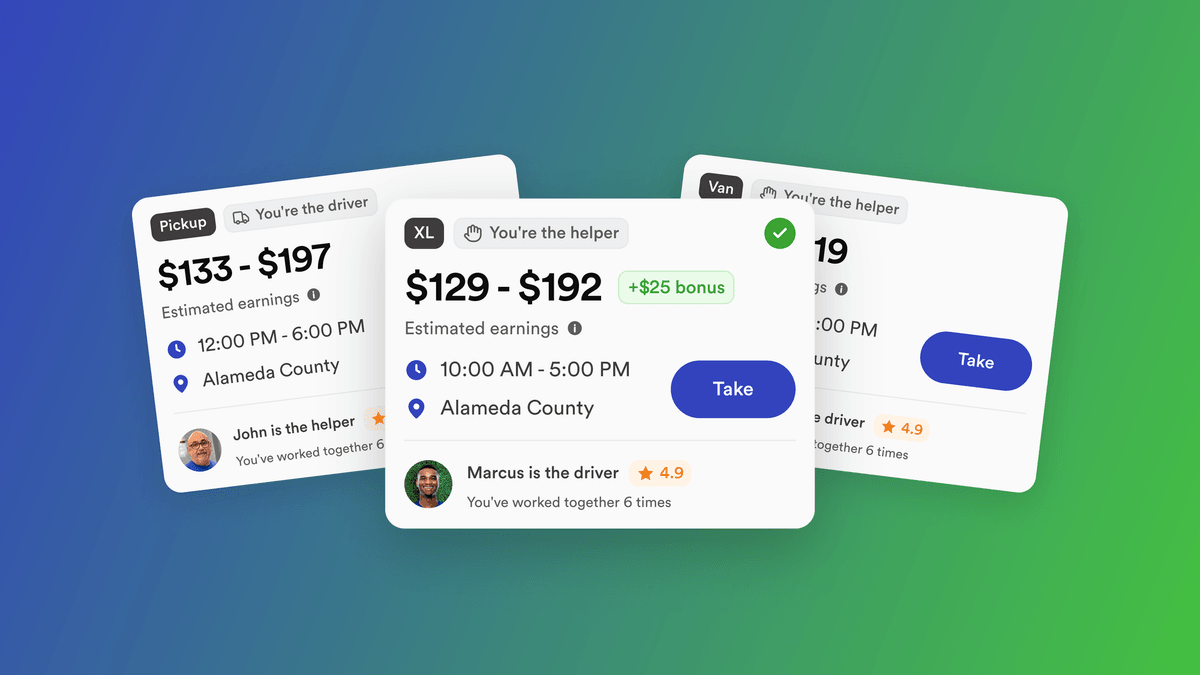
On-demand moving and delivery is one of the highest-paying flexible options on this list, and it's the one you can switch off the week school starts again. Luggers pick up slots — time windows tied to a region, like 7:45 AM to 2 PM — and take the jobs that come in during that window. You choose which slots and which weeks, so the work fits around camping trips, family obligations, or whatever else your summer involves.
Lugg is an on-demand moving and delivery service with more than 1.5 million moves completed across more than 4,000 U.S. cities. Here's why the pay structure works for teachers:
- You're paid per job, and it lands the same day you work. You don't wait on a weekly direct deposit.
- Tips go to the Luggers on the job. Customers aren't required to tip, but many do, and tips come on top of what you earn on the fare.
- Your starting rate is a floor, not a ceiling. The more you work and the higher your rating, the more earning potential you unlock over time.
- You work when you want. There are no required minimum hours and no fixed weekly commitment — if you don't want to work a given week, don't pick up any slots. Once you're committed to a slot, you see it through.
Two ways teachers join, and they pay differently:
- As a driver, with a pickup truck, cargo van, sprinter van or box truck that's 2001 or newer — no sedans or SUVs. Drivers are 21 or older and average $28 to $47 an hour depending on the vehicle, plus tips, and they bring their own moving equipment (blankets, straps, dollies, stretch wrap). Lugg allows rentals in some markets through specific approved rental partners — check with Lugg's onboarding team before you rent anything for the summer.
- As a helper, the second half of a two-person crew, if you don't have a qualifying vehicle. You'll need a government-issued photo ID, a smartphone, and the ability to lift up to 125 lbs on your own (250 lbs with your crew). Moving helpers are 18 or older and average $18 an hour plus tips, pairing with a driver to handle the loading, unloading and customer updates.
Signing up to become a Lugger is a short form that takes about two minutes, and most new Luggers are activated within the week. For a deeper read on the driver side, Drive for Lugg covers vehicle requirements and the activation flow, and the helper guide walks through the smartphone-only sign-up. If you're weighing gig work against traditional driving roles like UPS, UPS driver jobs vs. gig apps breaks down the trade-offs.
Is Lugg right for every teacher? No. The work is physical — you have to be comfortable lifting up to 125 lbs and moving furniture, and a lot of jobs happen outdoors in summer heat. But if you're physically up for it, want a change of pace from the classroom, and need income that stops the moment school starts again, it asks for no commitment beyond the slots you pick up.
7: Rideshare and food delivery
Uber, Lyft, DoorDash, Instacart, and Uber Eats are the obvious choices if you have a reliable car. Pay typically runs $15–$30 per hour after expenses, with peaks during evenings and weekends. The work is highly flexible, but per-job pay is smaller than moving-and-delivery work — you're trading higher per-trip pay for volume.
8: Pet sitting and dog walking
Rover and Wag pay $15–$30 per hour for walks and $35–$75 per visit for sitting and boarding (boarding pays the most). Summer is peak demand because families travel, and teachers with a yard or a pet-friendly home are well placed to fill a boarding calendar.
Remote and online summer jobs
9: Online course creation
If you have a niche you've taught for years, you can build a course on Outschool, Udemy, Teachable, or Thinkific and earn passive income through the summer and beyond. The catch: the first 1–3 months are mostly upfront work with no guaranteed return. Teachers with an existing audience — a TeachersPayTeachers following, a popular social presence — see the best results.
10: Virtual assistant or freelance work
Upwork, Belay, Fiverr, and Contra are the largest marketplaces. Teachers do well as virtual assistants ($20–$50/hour), proofreaders ($25–$60/hour), and freelance writers because the skill stack — organization, communication, editing — is exactly what clients need. The first two weeks are about building a profile and landing your first few reviews.
Travel and seasonal summer jobs
11: ESL or teaching English abroad
Short-term summer ESL programs run 4–10 weeks and pay $1,500–$3,000 per month, often with housing included. WorldTeach, CIEE, Greenheart Travel, and Teach Away run the most reputable programs. A TEFL certificate (40+ hours, around $300 online) is required for most paid roles. This is the option teachers pick when summer is the trip more than the paycheck.
12: Summer school substitute teaching
Most districts run shortened summer school for credit recovery or enrichment and pay substitute teachers $130–$200 per day. You're already credentialed, you already know the system, and you can apply through your district's HR portal in about an hour. Slots are limited, but if you get one the work runs 4–6 weeks and pays consistently.
How to choose the right summer job for you
The two most useful filters are how much you need to earn and how much social energy you have left. If you need to close a real income gap ($5K+) and have the bandwidth, stacking is the move: a higher-paying anchor job (test prep, curriculum writing, residential camp) plus a flexible gig (Lugg, tutoring) for the gaps and weekends.
If your goal is to rest with a little income on the side, lean toward the most flexible options on the list — gig work and online tutoring — where you can turn it off the moment you need a real break.
Pick your anchor job, then fill the gaps around it
Pick one anchor job that fits the bandwidth you actually have, then stack something flexible on top for the weeks you want more income. If the flexible piece is what you're missing and you're in one of the more than 4,000 U.S. cities Lugg operates in, signing up to drive or help on Lugg takes about two minutes and most new Luggers are activated within the week.
Galina Hyland
Galina leads operations at Lugg, writing about logistics, supply, and what it takes to power same-day moving at scale.
Subscribe to the Lugg blog
Get the latest moving tips, guides, and Lugg news delivered to your inbox.
Read more about Lugg moves

Holiday jobs near me: flexible work through January
Flexible jobs: work the hours you actually have

Weekend jobs near me: how to earn on Saturday and Sunday only

Jobs for college students that work around class