What pickup trucks qualify to drive for Lugg?
A brand-new F-150 can fail while a 15-year-old work truck passes. Eligibility is all about the bed — here's the quick check, the crew-cab catch, and how to measure yours.

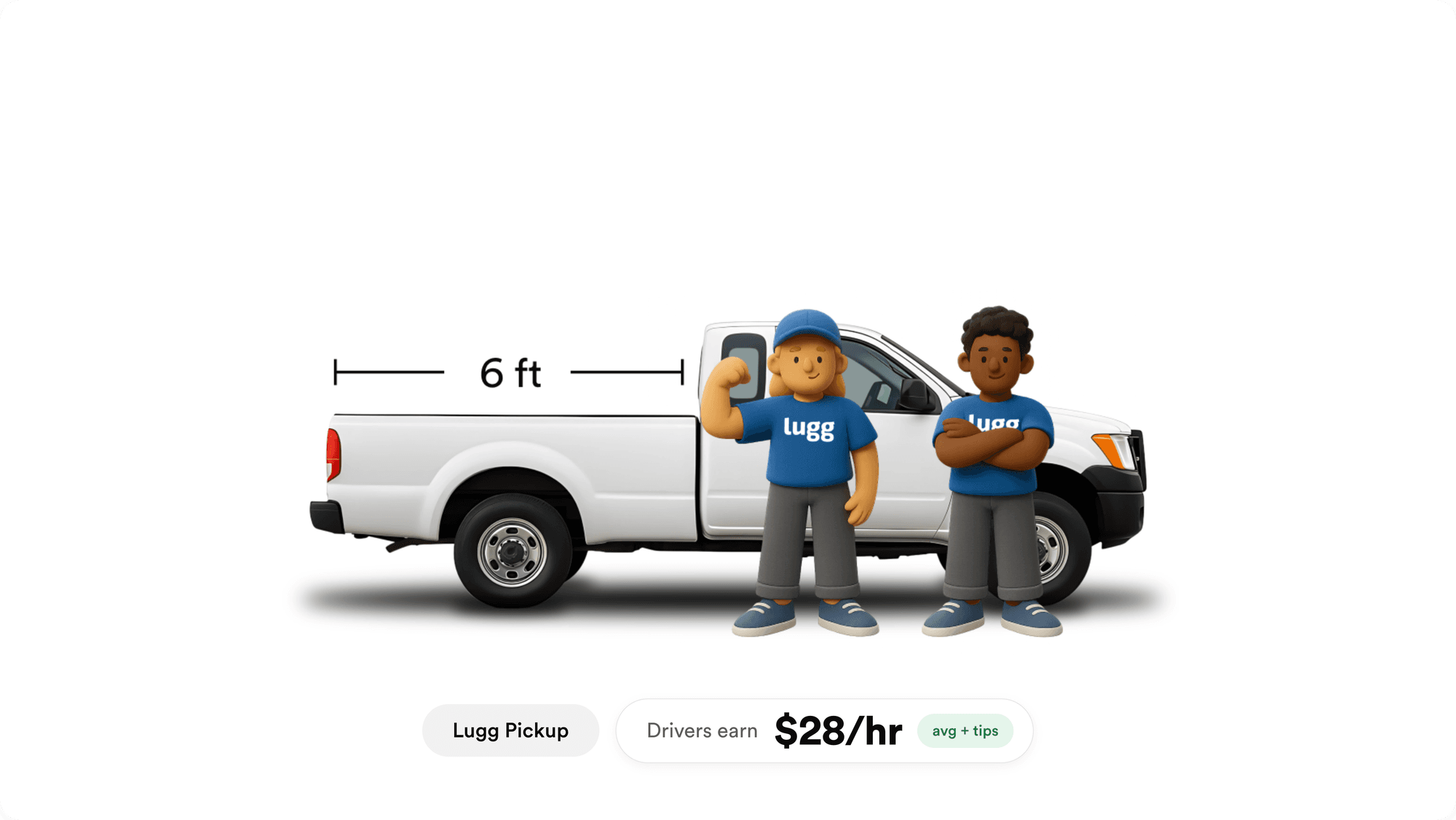
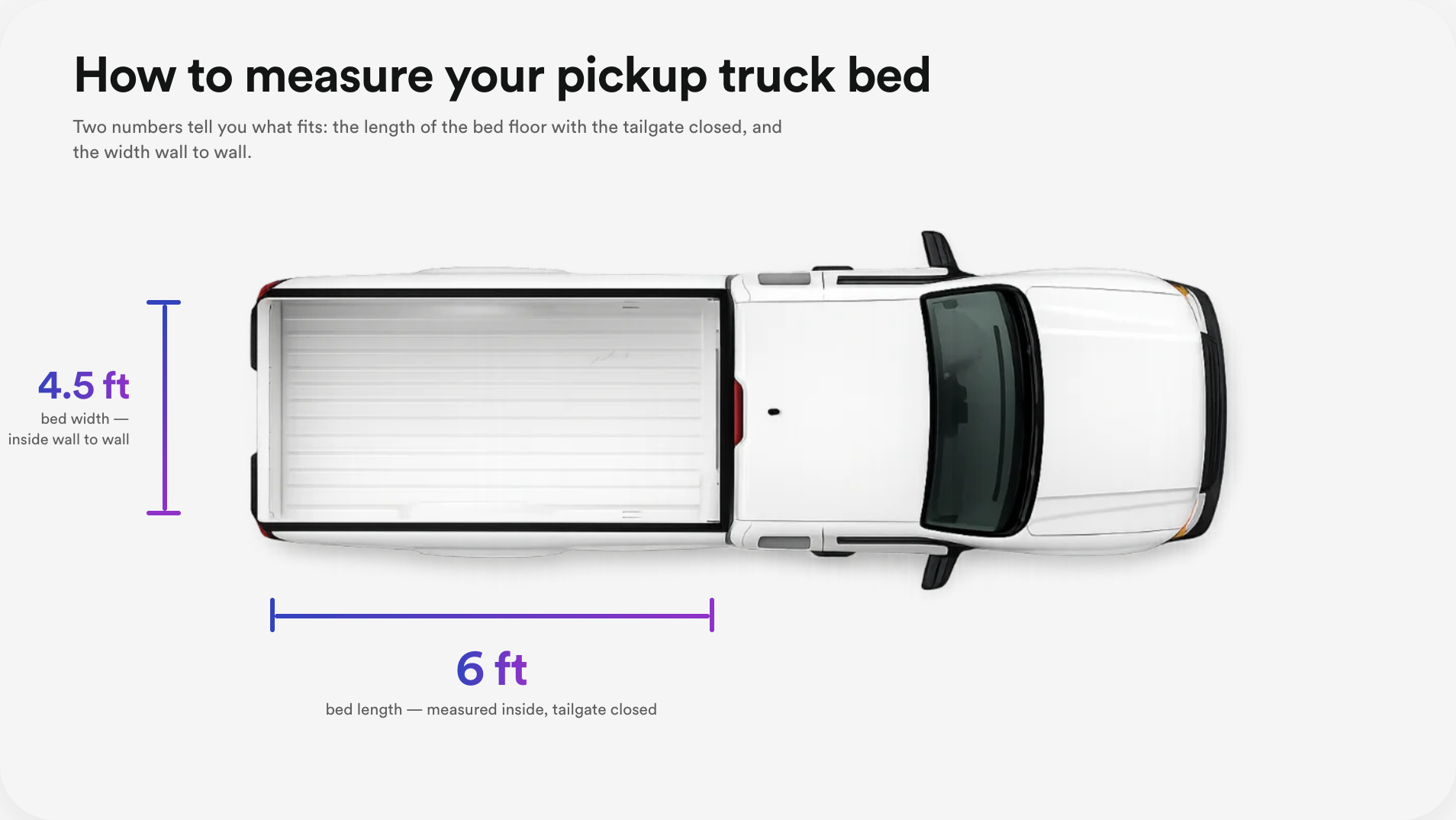
Whether your pickup qualifies to drive for Lugg comes down to one thing: the cargo bed. The truck needs a bed at least 6 feet long and 4.5 feet wide, a model year of 2001 or newer, and good cosmetic condition — no significant dents or damage. Any hard cap or bed cover has to come off. If the bed clears those numbers, the make, trim, and badge don't matter.
That last part trips people up more than you'd expect. Crew cabs — the four-door body style — now make up roughly 90% of pickup sales, and that four-door layout is usually paired with a shorter bed to keep the truck a manageable length. So the most common pickup on the road today is also one of the likeliest to miss Lugg's 6-foot minimum. A brand-new F-150 can fail the check while a 15-year-old work truck passes it without a problem. This post walks through exactly how to tell which one you're driving.
Does your pickup qualify for Lugg? The quick check
Here's the whole checklist in one place. If your truck is a yes on every row, it's eligible to take pickup jobs on the Lugg platform.
Pickup truck requirements for Lugg
| Requirement | What Lugg needs |
|---|---|
| Bed length | 6 feet or longer (measured inside, tailgate closed) |
| Bed width | 4.5 feet or wider |
| Model year | 2001 or newer |
| Cosmetic condition | Good shape — no significant dents, scratches, or body damage |
| Bed caps and covers | Hard caps and tonneau/bed covers removed |
| Rentals | Allowed through specific approved companies — confirm with Lugg's ops team first |
Which pickup truck models qualify for Lugg?
Eligibility ultimately depends on the bed length: the same model can pass or fail depending on which cab and bed you got. That said, here's the practical lay of the land.
Full-size trucks
The Ford F-150, Chevrolet Silverado 1500, RAM 1500, GMC Sierra 1500, and Toyota Tundra are the safest bets, but only when they came with a standard or long bed. Ordered with the standard 6.5-foot bed or the 8-foot long bed, they clear the minimum comfortably. Ordered as a crew cab with the short bed, many of them don't. More on that trap in a second.
Mid-size trucks
The Toyota Tacoma, Ford Ranger, Chevy Colorado, and Nissan Frontier can qualify, but you have to check. Their beds tend to run from about 5 feet on the short configurations up to a little over 6 feet on the longer ones. A long-bed Tacoma clears it; a short-bed one usually doesn't.
Compact trucks
The Ford Maverick and Hyundai Santa Cruz almost always fall short. Their beds are built around roughly 4.3 to 4.5 feet, which is great for a hardware run and too small for the furniture and appliances Lugg customers book. They're a no for the platform, even though they're genuinely useful trucks.
So measure by the number on the bed floor, not the model name. Plenty of full-size trucks fail on a short bed, and some mid-size trucks clear it.
The short-bed and crew-cab catch
This is the single most common reason a truck owner is surprised to find out they don't qualify. Pickups come in a few bed lengths — usually a short bed (around 5.5 to 6.5 feet on a full-size), a standard bed, and a long bed near 8 feet. The catch is that the short bed and the four-door crew cab are almost always sold together. You add back-seat room, the factory shortens the bed to keep the overall truck from getting unwieldy.
So the exact truck that's most popular right now — a full-size crew cab with a short bed — is the one most at risk of measuring 5.5 feet and landing just under Lugg's 6-foot line. That's frustrating when the truck looks plenty big, but a half-foot is the difference between a mattress or a dresser sitting flat and safe versus hanging off the tailgate.
The good news is the same model often qualifies in a different configuration. A Ford F-150 SuperCrew with the 6.5-foot bed clears it. An F-150 in a regular or extended cab with the 8-foot bed clears it easily. The same model, then, can be out in one configuration and fine in another. Which is exactly why you measure before you assume.
How do I measure my truck bed?
Measuring takes two minutes and settles the question for good. Advertised bed sizes are rounded, and real beds can run a couple inches shorter than the brochure number — so on a truck that's close to the line, the tape is the only thing that counts. Do it like this:
1: Close the tailgate.
2: Hook your tape measure against the inside of the closed tailgate.
3: Run the tape flat along the bed floor to the inside front wall (the bulkhead).
4: Read the number where it meets that front wall — that's your usable bed length.
For width, measure straight across the inside of the bed, wall to wall — that's the 4.5 feet Lugg is looking for. And the tailgate can stay down to add length when you're hauling.
Measuring first is a habit good Luggers build early. As one Lugger in Houston put it after a customer's new stove turned out wider than her door frame, the job goes smoothest when someone checks the numbers before anyone starts lifting. Your own truck is the first thing worth measuring.
Can you use a rental truck or a trailer for Lugg?
Rentals can work, but not just any rental. Lugg accepts rentals only through specific approved rental companies, so you'll need to check with Lugg's operations team to confirm a rental qualifies before you count on it. If it clears, a rental is a real way to test the work before you buy a truck of your own.
Trailers are more of a maybe. A pickup paired with a large open or enclosed trailer can be accepted case by case, but it's not an automatic yes — the setup, hitch, and how you'll safely load it all factor in. If a trailer is your plan, don't assume; confirm it during sign-up rather than showing up with it.
And if the pickup route is a dead end for you, remember it's not the only qualifying vehicle. A cargo van, sprinter, or box truck opens up the larger Lugg vehicle tiers entirely — worth knowing if you're deciding what to buy or rent next. Once your vehicle is sorted, the ways a qualifying truck actually earns are their own conversation.
No qualifying truck? You can still ride along as a helper
Not having a truck that makes the cut doesn't shut you out. Lugg runs on two roles, and only one of them needs a vehicle.
Drivers bring the qualifying pickup and basic moving equipment, and take the larger share of each job because they're providing the asset. Helpers need a smartphone and muscle, nothing else — no truck, no equipment. Helpers work in two-Lugger crews alongside a driver, and while the per-job share is smaller than a driver's, the bar to start is far lower. If you can lift safely and show up on time, the helper path is open regardless of what's in your driveway.
Either way you get paid the same day you work — money hits your account the day of the job rather than a week later. For a pickup driver, what you earn tracks the hours you put in — a median of about $28 an hour. Work part-time, roughly 40 hours a month, and that's around $1,100 a month; step up to full-time, about 40 hours a week, and the median is closer to $4,850 a month.
Helpers earn a smaller hourly share, since they're not bringing the vehicle. If you're weighing the roles, signing up as a Lugger is the same short form for both; you tell us whether you're bringing a vehicle. The full breakdown of pay and how the work runs lives in our guide to driving for Lugg.
Check your bed, then start your Lugg sign-up
The whole eligibility question fits on a tape measure. If your pickup has a bed that's 6 feet long and 4.5 feet wide, it's a 2001 or newer, it's in good cosmetic shape, and the cap or cover is off, your truck qualifies — full-size or mid-size, expensive or paid-off, it doesn't matter. If it's a crew-cab short bed sitting at 5.5 feet, it doesn't, and now you know why before you waste a trip.
Measured your bed and it clears the line? The sign-up takes about two minutes at lugg.com/become-a-lugger, and the team typically activates you within the week once your background check clears. No qualifying truck? Sign up as a helper with just your phone and ride along with a crew. Either way, the first move is knowing your numbers — so go measure the bed.
Galina Hyland
Galina leads operations at Lugg, writing about logistics, supply, and what it takes to power same-day moving at scale.
Subscribe to the Lugg blog
Get the latest moving tips, guides, and Lugg news delivered to your inbox.
Read more about Lugg moves
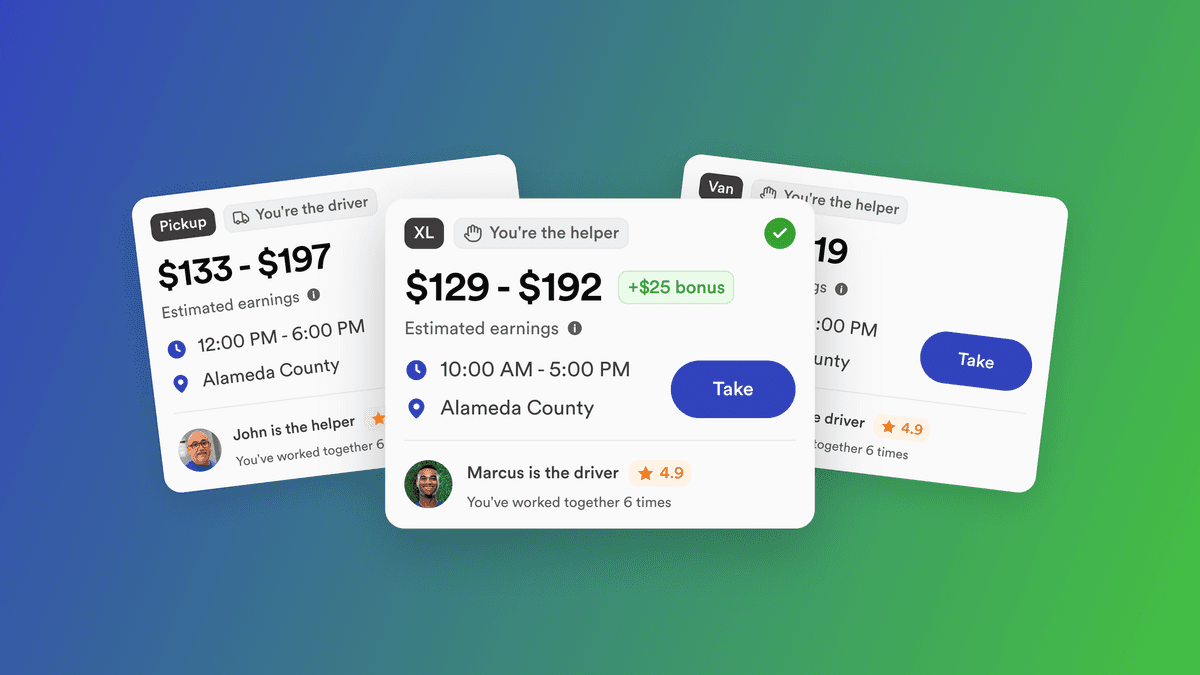
Flexible jobs: work the hours you actually have
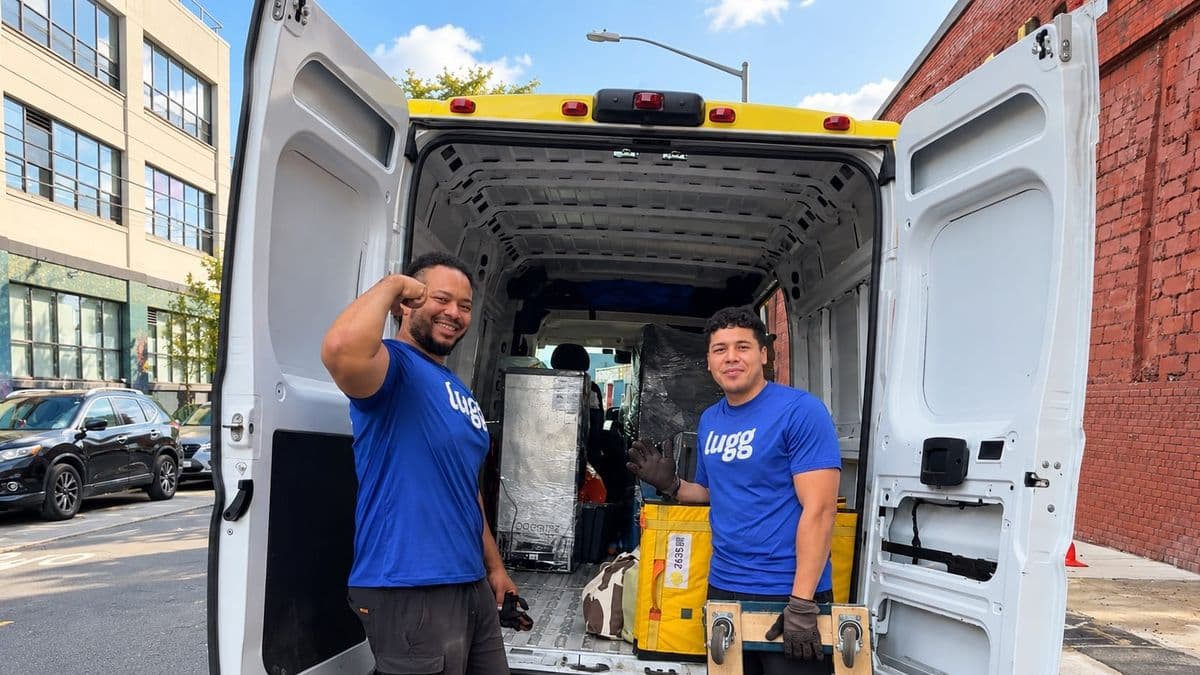
Weekend jobs near me: how to earn on Saturday and Sunday only

Jobs for college students that work around class
What a decade of gig work actually pays
