How to Find Free Moving Boxes (and How Many You Need)
Find free moving boxes at grocery stores and local groups, then choose the sturdy ones that are actually worth carrying home.

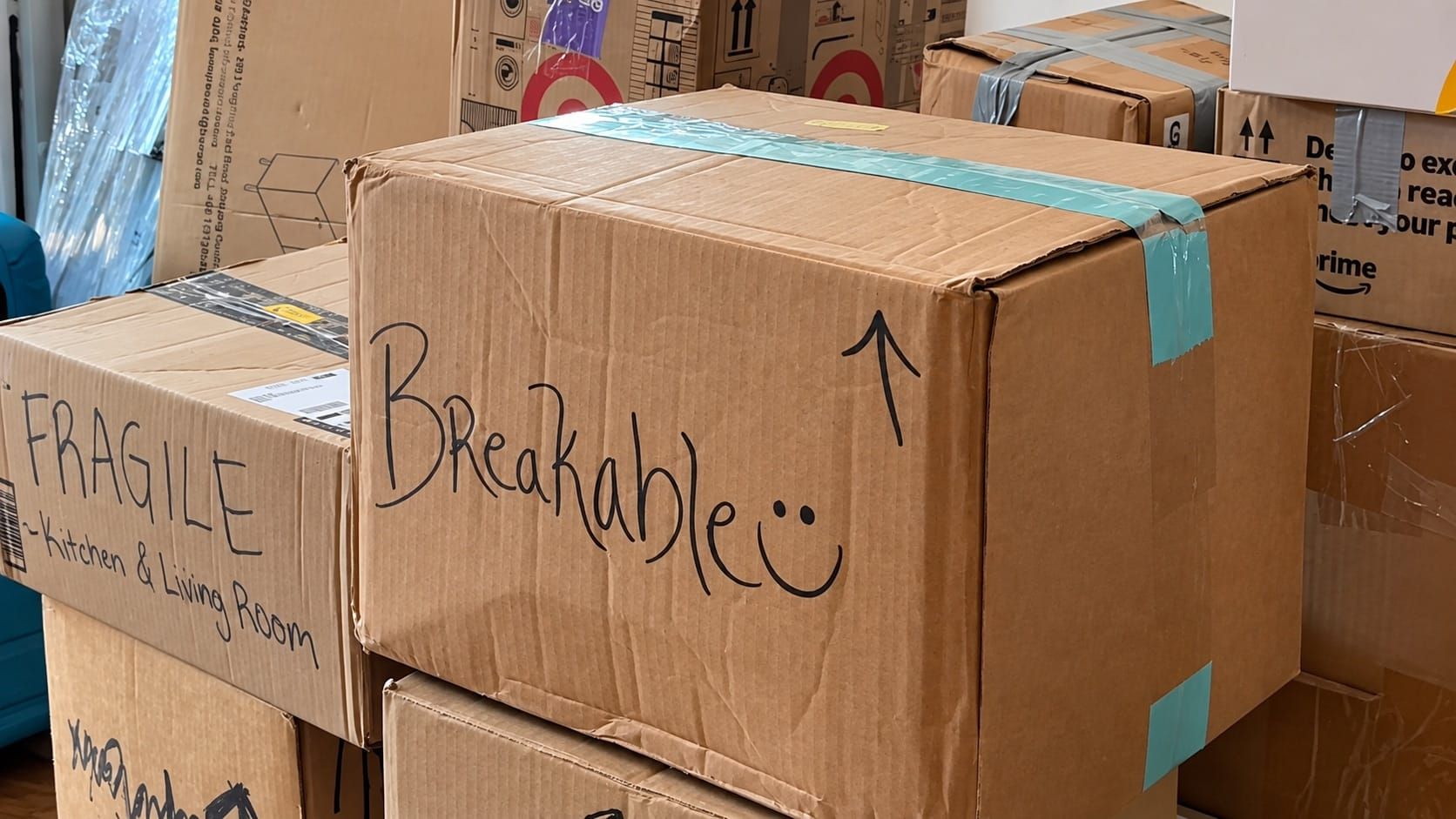
The easiest places to find free moving boxes are grocery stores, liquor stores, bookstores, and apartment recycling rooms. Grocery stores are often the simplest first stop: ask when their next delivery arrives and whether they can set aside clean, dry boxes before the cardboard is flattened. Local Buy Nothing and neighborhood Facebook groups are another good bet when you want a whole set from someone who has just unpacked.
How many boxes you need depends on the size of your move and what you own. Bulky furniture does not need to go in a box, so focus your cardboard on the things that do: books, dishes, clothes, pantry items, and smaller household goods. Lugg is an on-demand moving and delivery service that handles anything from a few boxes headed to storage or across town to the furniture and boxes in a full apartment move. You choose the vehicle that fits the load, from a pickup truck to a box truck, and movers arrive with furniture blankets, stretch wrap, and dollies.
How to find free moving boxes
| Where to look | What you may find | When to ask |
|---|---|---|
| Grocery stores | Clean small and medium shipping boxes | Call ahead and ask when deliveries are unpacked |
| Buy Nothing, Facebook, and Nextdoor groups | Used moving boxes in several sizes, sometimes as a complete set | Post your request before making store visits |
| Liquor stores | Sturdy small boxes, often with cardboard dividers | Ask after a delivery, before the boxes are flattened |
| Bookstores | Small and medium boxes built to carry heavy books | Call and ask when shipments are unpacked |
| Offices and schools | Matching copy-paper boxes with removable lids | Ask after paper and supply deliveries |
| Apartment recycling rooms | Flattened boxes in mixed sizes | Check after busy move-in days and follow building rules |
| Big-box, department, and pet stores | Larger boxes for lightweight, bulky items | Ask the receiving department when stock is unpacked |
1: Ask grocery stores about their delivery schedule
Grocery stores are worth calling before you drive over. Ask whether their boxes are clean and dry, and whether they can save a few after a delivery. Avoid produce boxes that are damp, waxed, or open-topped.
2: Check local Buy Nothing and Facebook groups
Local Buy Nothing and neighborhood Facebook groups can be the fastest route to a whole set of boxes. Post your neighborhood, move date, and rough box count, or search recent posts from people who have just unpacked. Availability varies, but one pickup can save several store runs.
3: Ask liquor stores for sturdy small boxes
Liquor stores are the best cardboard in retail. The boxes are built to carry twelve glass bottles without failing, which makes them the right size and strength for books, plates, and anything heavy. Many still have the cardboard cell dividers inside, and those are the reason a set of wine glasses arrives intact. Ask in the morning, because most stores break down the previous night's delivery boxes before lunch.
4: Ask bookstores for boxes built to carry weight
Bookstores are the small-box source nobody uses. Books are the heaviest thing per cubic foot in most homes, so the cartons publishers ship them in are rated for that weight at a size one person can still carry. Small is the size everyone runs out of, and unlike liquor stores, almost nobody has thought to ask.
5: Ask offices and schools for copy-paper boxes
Copy-paper boxes are the ones to go out of your way for. They come with a separate lid, so they don't need taping shut and they can be opened and closed a dozen times during unpacking. They're also the one box you can get thirty of in a single identical size, which is what makes them stack. If you know anyone who works in an office, this is the easiest ask on the list.
6: Check apartment recycling rooms after move-in days
Apartment recycling rooms often run on the lease calendar. When a building has a move-in wave, its recycling area can fill with flattened cardboard from new arrivals. In a big building, that can be an entire move's worth in one trip down the hall. In Boston, the September move-in rush leaves so much furniture and cardboard on the curb that locals call it Allston Christmas.
How many moving boxes do you need for a one-bedroom apartment?
Box-count guides vary. ApartmentGuide estimates 45 boxes for a one-bedroom, broken into 7 small, 14 medium, 13 large, and 11 extra-large. Treat any published total as a planning range, not a shopping list.
Those estimates assume different home sizes and packing habits, and many assume that nearly everything soft gets boxed. In practice, clothes can travel in dresser drawers when appropriate, bedding and pillows fit in bags or a duffel, and lamps and rugs do not need cardboard at all.
For a lightly furnished one-bedroom, start with about 20 boxes, weighted toward small and medium, then add tape, labels, and the other moving supplies you need once you can see what's left. You may need more boxes if you have a large book collection, a kitchen full of fragile items, or a lot of closet storage. Small boxes are the ones people run out of, because heavy things have to go in them. Large boxes are the ones people over-collect and then fill with something too heavy to lift.
How to choose a free used moving box
Use only boxes that are clean, dry, odor-free, and structurally sound. Free boxes are worth the two seconds it takes to look them over.
- Squeeze the corners. If the cardboard is soft or the flaps separate, it has been damp at some point and it won't hold weight.
- Skip anything that held produce. Produce boxes are often waxed, frequently open-topped, and they've carried moisture.
- Skip anything stored outside. A box that sat by a loading dock in the rain is a box that will fail on a staircase.
- Check the bottom seam. A box that was opened by slicing the bottom rather than the top needs re-taping before you trust it.
- Take the lids. Copy-paper and banker's boxes are worth twice as much with their lids, and people leave them behind.
Matching sizes are worth chasing. Boxes of one footprint stack into a square column that fills a truck wall to wall, and a load of a dozen different box shapes leaves gaps you're paying to drive across town. This is the real argument for the copy-paper box: twenty identical ones load faster and safer than thirty good mismatched ones.
If you would rather buy something you can use again, reusable plastic totes work well for books, pantry items, and supplies you will unpack quickly. Reusable laundry or moving bags are another good fit for linens, coats, pillows, and other soft items. Use bags for light, compressible things, not fragile or heavy loads that need a rigid box.
What doesn't need a box at all
You don't need boxes for the bulkiest pieces in a home: sofas, mattresses, dressers, tables, and headboards.
Sofas, mattresses, dressers, tables, and headboards travel under furniture blankets and stretch wrap. Movers booked through Lugg arrive with dollies, moving blankets, stretch wrap, forearm lifting straps, tie-down straps, and basic tools. Pickup trucks also carry a tarp.
Moving blankets leave with the crew. If movers are loading a rented truck or storage container that you will transport yourself, have your own blankets ready for the drive. Stretch wrap is consumable and stays with your things.
Roll and wrap rugs, remove lamp shades and pad the bases, and transport screens upright instead of flat. Artwork and mirrors are the exception: a picture box is one of the few specialty boxes worth buying new.
When to start looking for moving boxes
For a one-bedroom, three weeks out is a useful starting window. That is long enough to catch two liquor-store delivery cycles and a weekend of Buy Nothing posts, but short enough that you are not storing flattened cardboard in your hallway for a month.
Post the ask before you go collecting. A local Buy Nothing, neighborhood Facebook, or Nextdoor post that names your neighborhood and rough box count can connect you with someone who has just unpacked—and can save several store runs.
How you ask a store matters as much as when. Ask whether they have boxes going out that day, rather than assuming the store has a giveaway policy. A manager may be able to tell you when deliveries arrive or cardboard is flattened. If they give you a day, show up then—availability and store policies vary.
In the final week, fill the gaps after you have packed the heavy and fragile items first. Small boxes are usually the first to run short.
Getting it all to the new place
Once the packing is done, the sofa, mattress, and boxes still need a vehicle larger than most cars.
If you'd rather not borrow a truck and call in favors, book residential movers through Lugg. You pick the vehicle that fits what you ended up with, from a pickup truck up to a box truck, and there are no hourly minimums, so a load that took you three weeks to box up doesn't have to be padded out to a four-hour booking. If you're only missing the muscle and you've already got the truck, moving help is the same crew without the vehicle.
After you unpack, offer the boxes to a neighbor or local Buy Nothing group while they're still clean and sturdy. Flatten and recycle anything that is torn, damp, or too soft to reuse.
Loren Couse
Loren manages Growth and Online Strategy at Lugg. With a deep passion for consumer technology, he stays on the cutting edge of the latest digital trends. When he isn’t strategizing, he spends his free time building personal coding projects.
Subscribe to the Lugg blog
Get the latest moving tips, guides, and Lugg news delivered to your inbox.
Read more about Lugg moves
Moving to Salt Lake City: where to live along the Wasatch Front

How to move with a cat and minimize stress

Moving to Las Vegas: where to live across the valley
How to move a couch through a narrow doorway or hallway