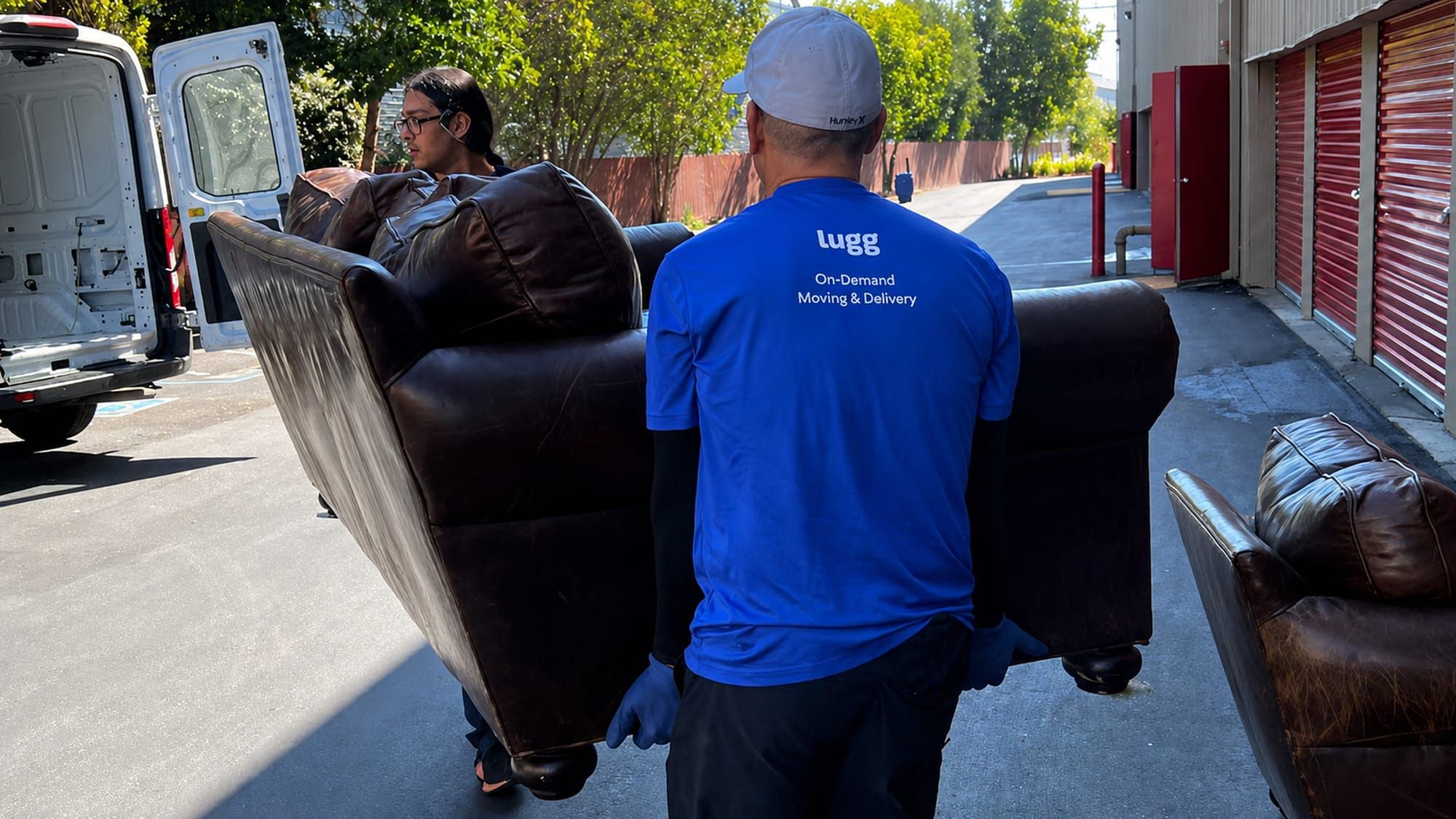
How to move a couch through a narrow doorway or hallway
A couch that looks two inches too big for the door usually isn't. Here's the pivot, the door-hinge trick, and the four numbers to measure first.

To move a couch through a tight doorway or hallway, stand it on one end and pivot it through at an angle. The diagonal of a sofa is almost always shorter than its full width, so a couch that looks two inches too big for the door usually isn't. That single move — sometimes called the hook, or just the pivot — is what gets most couches through most doors.
It helps to know what you're up against. A standard three-seat couch weighs 100 to 250 pounds, and almost none of that weight sits where you can get a decent grip on it — no handles, a frame that flexes, and a shape that wants to swing. That's what makes it a two-person job before it's ever a technique problem. Handing it off is also cheaper than most people assume: the median single-couch move on Lugg runs about $140. Lugg is an on-demand moving and delivery service that moves couches, sofas and sectionals, with movers and a truck on the way within the hour for a piece that's too big for a car or too heavy to take down stairs on your own.
Here's how to read the angles, prep the couch, and get it through without gouging a wall or your lower back.
The quick version
| Your situation | The move that works | People you need | Gear you'll want |
|---|---|---|---|
| Standard couch, normal door | Stand it on one end, pivot through at an angle | 2 | Moving blankets, straps |
| Loveseat or lighter sofa | Carry flat, turn on its side for the hallway | 2 | Furniture sliders, blankets |
| Sectional | Split it into sections first | 2 | Screwdriver, blankets |
| Sleeper / hide-a-bed | Strap the fold-out shut, then pivot | 2–3 | Straps, dolly |
| Down a staircase | High-low carry, one person above, one below | 2–3 | Blankets (skip the dolly on stairs) |
| Won't fit any door | Take the door off, then the legs and arms | 2 | Hammer, screwdriver |
Measure before you lift a thing
Before anyone picks up anything, measure the couch and every doorway on the path. You need four numbers: the couch's length, its height, its diagonal depth (corner to corner through the body), and the width of the narrowest doorway in the way. If the couch's diagonal is smaller than the door opening, it will go through — you just have to angle it right.
Most interior doorways are 30 to 32 inches wide, and front doors are usually 36. A three-seat couch is typically 78 to 96 inches long, which is why length rarely matters and depth almost always does. To find the diagonal, measure from the top back corner to the front bottom edge through the body of the couch. That's the number the doorway actually has to beat.
Walk the whole route once empty-handed: the entry door, the turn into the hallway, any stair landing, the doorway into the destination room. The tightest point on that path decides everything.
Then prep the couch so it's carrying as little bulk as possible. Pull off the cushions and set them aside. Unscrew the legs or feet. Wrap the body in a couple of moving blankets and a few passes of stretch wrap — that protects the upholstery and your doorframes in one step. If your floors scratch easily, lay down a runner or slide furniture pads under the feet before you start. The couch is rarely what gets damaged on a move; the hardwood underneath it often is.
How do you move a couch through a narrow doorway?
Stand the couch vertically on one end and walk the bottom corner through the door first, then rotate the rest around the frame in one slow, continuous turn. Most sofas are wider than they are deep, so going vertical hands you the couch's narrowest profile to work with. That's the whole trick behind the pivot.
1: Tip the couch up onto one arm
Stand it vertical with the seat facing you, so the back is flat against your body and the feet are off the ground. Do this in the open room, not in the doorway — you want the couch already standing before it reaches the tight spot.
2: Lead the bottom corner into the doorway at about 45 degrees
Angle the low corner into the opening first and push it past the frame. Going in square is what jams a couch; going in on the diagonal is what clears it.
3: Rotate around the frame as the first end passes through
Have your partner on the far side pull and turn while you feed the trailing end through behind them. The couch should be hooking around the frame, following the corner that's already clear.
4: Keep it moving in one motion
Don't stop halfway. A stalled couch is where knuckles get scraped and doorframes get gouged, because the weight settles against the frame and someone has to muscle it out again.
If it's snug but close, that's normal — a little wiggle and a steeper angle usually finish the job. One person should own the tight side of the frame and call the shots, since they can see the pinch points the lifter can't. If it flat-out won't clear the opening, don't force it. Shoving a stuck couch is how you crack a frame or split a seam, and the next section has better options.
What if the couch still won't fit through the door?
Take the door off its hinges first. That's the fastest inch or two you'll find, and it costs you five minutes. Tap the hinge pins up and out from the bottom with a screwdriver and a light hammer tap, lift the door away, and try the pivot again before you take anything off the couch itself.
Still tight? Work down this list in order:
- Remove the hinges and door stop. Unscrew the hinge plates from the frame and pry off the door-stop trim (the thin strip the door closes against). That buys you close to another inch of width.
- Take off the legs and any bolt-on arms. Many couches have arms that unbolt from the frame. Losing them can drop the depth by several inches.
- Split a sectional. Sectionals are built to come apart — check underneath for the connecting clips or brackets and move each piece on its own.
If none of that works, the couch may simply be bigger than the building will allow, and the honest answer is that it needs to go through a window or over a balcony. That's a rigging job for people with the right straps and gear, not a two-friends-and-a-Saturday project. Worth knowing where the line sits: Lugg movers carry couches up stairs, into elevators and down long hallways, but they won't hoist an item over a railing, so that scenario needs a specialty crew.
Getting a couch down a hallway and around a corner
In a tight hallway, turn the couch on its side so the seat faces one wall and the back faces the other. That gives you the slimmest width to walk it down. Slide a pair of furniture sliders under the leading end if the floor allows, so you're guiding rather than dead-lifting the whole way.
Corners are their own puzzle. Pivot around the inside of the turn: the person leading swings their end into the new direction first, while the person trailing feeds the back end around the corner. Go slow and talk to each other — "lift," "down," "my end's clear" — because whoever can't see the far end is working blind. It's the same footwork furniture movers use, and it's mostly patience.
Moving a couch down stairs (or up)
On stairs, the person at the lower end carries most of the weight and sets the pace, while the person up top guides and keeps the couch tilted back into the staircase. Never take stairs with a couch alone. On stairs you can't keep the load close to your body or your back straight, and a couch gives you nothing solid to grip while you try — that combination is how a heavy carry turns into an injury.
Skip the dolly on stairs; it's for flat ground and loading, not steps. Keep the heavier end downhill, pause on landings to reset your grip, and clear the stairwell of rugs and shoes before you start. In an apartment building, reserve the elevator if there is one, and measure the elevator's diagonal too — a couch that pivots through a door can still be defeated by a small elevator cab. Elevator or not, apartment moves live and die on the turns between the unit door and the street.
How many people does it take to move a couch — and what it costs to skip it
A standard couch takes two people; a sleeper sofa or a large sectional takes three. If you'd rather not spend your Saturday sideways in a stairwell, the spread is narrower than most people picture. Across nearly 19,000 single-couch and sofa moves on Lugg over the past year, the middle half came in between $100 and $190 before tip. Where a particular move lands in that band mostly tracks how far it's going, since distance is billed as mileage between your two addresses rather than by how long the drive actually takes — so traffic on the way costs you nothing.
Booking a couch moving service through Lugg gets you same-day availability, and the blankets, straps and dolly are already in the vehicle. You pick the vehicle that fits the piece, you see the estimate before you book, and there are no hourly minimums the way traditional movers charge their 2-to-4-hour blocks. Every move is backed by the Damage Protection Guarantee, which matters more than usual when the couch is brand-new or barely fits. For a single piece going across town, that's usually less than a truck rental plus a tank of gas and a favor you'll owe someone.
If you're weighing the whole job rather than one piece, our guides to how big of a moving truck you need and moving a heavy dresser cover the same geometry problem for the rest of the room.
Get your four numbers before you get your friends
Almost every "this couch won't fit" moment comes down to measuring and angling. Get the length, height, diagonal and narrowest doorway. Take the door off before you take the couch apart. Pivot on one end through the tight spots, and keep it moving.
And if the geometry genuinely doesn't work, book last-minute movers through Lugg — upfront estimate, no hourly minimums, and someone else's back on the stairs.
Loren Couse
Loren manages Growth and Online Strategy at Lugg. With a deep passion for consumer technology, he stays on the cutting edge of the latest digital trends. When he isn’t strategizing, he spends his free time building personal coding projects.
Subscribe to the Lugg blog
Get the latest moving tips, guides, and Lugg news delivered to your inbox.
Read more about Lugg moves
Bought furniture on Black Friday? How to get it home today

Round Top Antiques Fair: how to shop it and get it home

Where unwanted furniture goes: why mattresses don't get a second life

Country Living Fair 2026: A Shopper's Guide to Rhinebeck