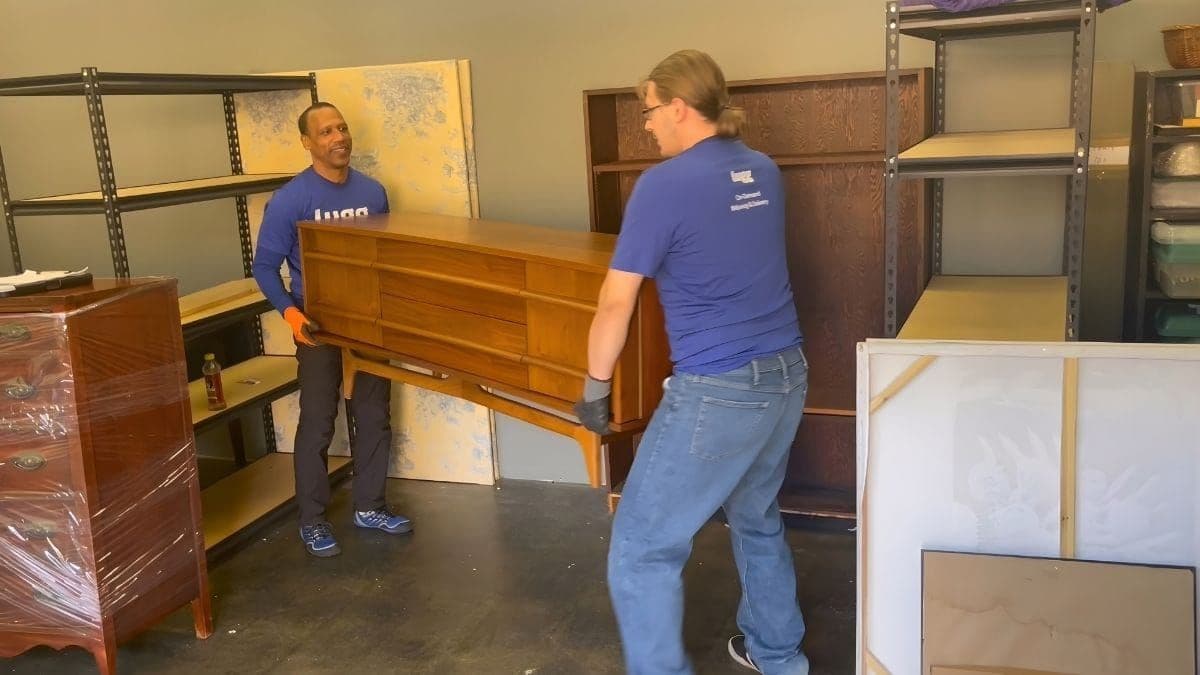
How to move a heavy dresser by yourself (and when not to)
That dresser is heavier than it looks. Here's the step-by-step — including what changes the moment stairs are involved.

The safest way to move a heavy dresser is to empty every drawer, remove or tape them shut, and walk it on a furniture dolly with two people and a pair of moving straps—never drag it by the top. A fully loaded six-drawer solid wood dresser can easily exceed 150–200 pounds — well beyond what most people can safely lift alone, and more than enough to cause a serious back injury if you try.
If it's solid wood or headed up or down stairs, it's worth paying someone else to do the lifting. Lugg is an on-demand moving and delivery service that moves dressers, armoires and tall chests between homes, floors or rooms, with movers and a truck on the way within the hour. Perfect for a piece that has to come down a staircase, or one that won't fit in your car. At Lugg over the past year, moving a single dresser in a pickup truck cost a median of $119 before tip, with the middle half landing between $97 and $152. This guide covers how to move a heavy dresser step by step — including what changes when carpet is involved, when stairs are involved, and when getting help is the smarter move.
How to move a dresser: step by step
1: Empty the dresser completely
Remove everything from every drawer — clothes, accessories, and any items stored on top. A fully loaded dresser can weigh 150–200+ pounds; emptying it typically reduces that by 30–50%. Don't skip this step or move it partially loaded. Drawers shift during movement, the weight is unpredictable, and the risk of tipping multiplies quickly.
Pro tip: Leave only pillows or very lightweight items inside drawers if necessary — they won't add meaningful weight and they're hard to pack separately. Everything else comes out.
2: Remove the drawers
Pull each drawer out completely and set them aside. Removing drawers does two things: it reduces total weight, and it shifts the center of gravity down on the frame, making the piece far less likely to tip when you tilt it. Most drawers pull straight out; if yours stop partway, look for small plastic tabs on the drawer slides and depress them, or tilt the drawer down slightly as you pull.
Stack the empty drawers separately and secure any contents inside with stretch wrap. Label them if you removed them from a multi-dresser setup so you can replace them in order.
Pro tip: If drawers won't come out at all due to the dresser's construction, tape them shut with painter's tape — never duct tape directly on wood finishes, which can leave residue or pull the finish.
3: Gather your equipment
You can't move a heavy dresser safely on strength alone. You need mechanical advantage. Collect these before you start:
- Furniture sliders: Non-negotiable for solo moves. Use felt sliders on hardwood, tile, or laminate. Use hard plastic sliders on carpet — felt digs into pile and the dresser won't budge.
- Lifting straps (moving straps): Highly recommended for two-person carries. These harnesses loop under the dresser and distribute weight across your forearms and shoulders rather than your lower back, making a 150–200 lb dresser feel significantly lighter. Forearm Forklifts are the most common style; most equipment rental stores carry them.
- Moving blanket: To protect the dresser surface during tilting and transit, and to protect walls and door frames.
- Stretch wrap (mover's wrap): To secure drawers and the blanket in place.
- Work gloves: For grip and hand protection.
- Tape measure: Measure the dresser width and height, then measure every doorway and hallway it needs to pass through. Standard interior doorways are 80 inches tall and 32–36 inches wide — verify yours before you start moving.
4: Clear and measure the path
Walk the full route from the dresser's current position to its destination. Remove rugs (which cause furniture to catch and tip), cords, and anything that could cause a stumble. Open all doors fully and prop them open. Check that the dresser will fit through every doorway — measure twice, especially for taller dressers with a mirror attached.
If a doorway is close to the dresser's width, try tilting the piece at an angle to gain a few inches of clearance. If it still won't fit, removing the door from its hinges adds 1–2 inches. Use the measuring tape, not your eyes — a half-inch gap can mean a stuck dresser and a damaged door frame.
Important: If the dresser has a mirror attached, remove it before moving and wrap it separately in bubble wrap between two pieces of cardboard. A mirror adds weight, height, and fragility — it dramatically changes the risk profile of the move.
5: Tilt and slide to your destination
Stand at one end of the dresser, bend at the knees (never your waist), and tilt the dresser back just enough to slide furniture sliders under the front two legs. Lower it carefully. Walk to the other end and repeat. Once all four legs are on sliders, the dresser should move with a fraction of the effort required to carry it.
Always push the dresser from behind rather than pulling it toward you. Pushing lets you use your legs more effectively, keeps your spine straighter, and gives you more control. On hardwood, tile, or laminate, never push without sliders or a moving blanket underneath first — bare legs dragged across a hard floor will scratch and gouge the surface. On carpet, use hard plastic sliders and apply steady forward pressure rather than short bursts. Move slowly — a heavy dresser that gets away from you is much harder to stop than one moving at a controlled pace.
6: Navigate stairs safely
Stairs fundamentally change how you move a dresser — and solo is not an option here. Standard furniture dollies aren't designed for stairs, and attempting to move a heavy dresser up or down steps alone creates a serious tipping and injury risk. Stairs are where most furniture-moving injuries happen, and a dresser getting away from you on a staircase has nowhere to go but down.
If stairs are involved, you have three options:
- Two people carrying: One person on the uphill end, one on the downhill end. The person going down backward carries the top; the person facing up controls the bottom. Lifting straps make this significantly safer — they distribute the load across both carriers' shoulders and keep the dresser from shifting mid-staircase. Take one step at a time, communicate before every movement, and rest on landings.
- Appliance dolly (hand truck): A two-wheeled hand truck with straps can work for lighter dressers on straight staircases. The dresser must be secured with ratchet straps, kept tilted against the dolly, and guided by at least two people — one controlling the dolly, one steadying from below.
- Professional movers: For tall dressers, heavy solid wood, spiral staircases, or three or more flights, professional movers with the right equipment are the right call. The cost is a fraction of what a back injury or a dropped dresser through a wall costs.
Important: Never attempt to move a heavy dresser up or down stairs alone. The dresser will win.
7: Protect the dresser during transport
Once the dresser is out of the room, wrap it in a moving blanket and secure the blanket with stretch wrap or painter's tape — tape should never touch the wood surface directly. This protects the finish from bumps and scratches and keeps knobs and hardware from catching on door frames.
When loading the dresser into a truck, stand it against the wall and secure it with ratchet straps to prevent tipping during transit. If you removed the drawers, load them flat or stack them with padding between. Replace them before securing the dresser if space allows — a dresser frame without drawers is more vulnerable to damage from shifted cargo.
Moving a dresser by yourself vs. with a friend: a quick comparison
| Factor | DIY solo | With a friend |
|---|---|---|
| Best for | Same-floor, flat surface, lightweight dresser | Stairs, heavy dressers, tight turns |
| Tools needed | Sliders, moving blanket, dolly | Sliders, lifting straps, dolly |
| Stair risk | High — do not attempt alone | Manageable with straps, one step at a time |
| Dresser weight limit | ~100 lbs or less | Up to ~200 lbs, on a flat floor |
| When to skip it entirely | Tall dresser, stairs, carpet without sliders | 3+ flights, no elevator, very heavy solid wood |
When to call in help
DIY can be the right move for a lot of dresser situations, but it's not always the safe move. Knowing the difference saves your back and your home.
Get help — either a friend or professional movers — when:
- Stairs are involved and there's no elevator
- The dresser is taller than you (highboys, armoires, and tall chests have a high center of gravity and tip easily when tilted)
- The dresser is solid wood and exceeds 150 lbs
- The path includes narrow hallways, sharp corners, or uneven surfaces
- There's a mirror attached that you can't remove
- Your gut says this is too much — listen to it
For situations where you need movers quickly — a last-minute Craigslist find, an inherited piece from a second-floor bedroom, or a move that turned out to be harder than expected — Lugg puts background-checked movers and a truck on the way within the hour, and you see the estimate before you book.
“Moved a large vintage dresser smoothly up a tight staircase. They arrived in 30 minutes, wrapped it securely, and delivered it in less than an hour. Made a daunting task seamless. Will definitely use Lugg again.” — Kaitlyn Coiner, Los Angeles (Google Reviews)
Working through the rest of the bedroom? The same rules apply to the two other pieces people get stuck on: how to move a couch and how to move a piano.
Frequently asked questions
Can you move a dresser with clothes still inside?
Only for a short slide across the same room, and only if the drawers are taped shut. For anything further than that, and for any move in a truck, empty it. The added weight strains joints and joinery, and drawers shift during transport — even with painter's tape, contents can move enough to damage the interior. It's also harder to navigate tight spaces with a loaded piece.
How much does it cost to hire movers just for a dresser?
On-demand movers are usually the cheapest way to move one piece, because there's no hourly minimum — you pay for the time and the vehicle the job actually takes. Traditional movers generally quote by the hour with a two-to-four-hour minimum, so a forty-minute dresser move still bills as most of an afternoon. On Lugg Lite, the smallest option, a single dresser cost a median of $77 before tip over the past year.
When the staircase makes the decision for you
Moving a dresser safely comes down to three things: make it lighter (empty it, remove the drawers), use the right equipment (sliders, a dolly, a moving blanket), and know your limits — especially when stairs enter the picture. Most same-floor moves are well within DIY range with the right prep. Everything changes the moment you're looking at a staircase.
If the dresser is going down a staircase you'd rather not think about, book dresser delivery through Lugg — movers and a truck on the way within the hour, and no hourly minimum on a job that takes forty minutes.
Loren Couse
Loren manages Growth and Online Strategy at Lugg. With a deep passion for consumer technology, he stays on the cutting edge of the latest digital trends. When he isn’t strategizing, he spends his free time building personal coding projects.
Subscribe to the Lugg blog
Get the latest moving tips, guides, and Lugg news delivered to your inbox.
Read more about Lugg loads

How to Find Free Moving Boxes (and How Many You Need)

Weekend jobs near me: how to earn on Saturday and Sunday only


How Home Staging Companies Actually Book Delivery


Jobs for college students that work around class
