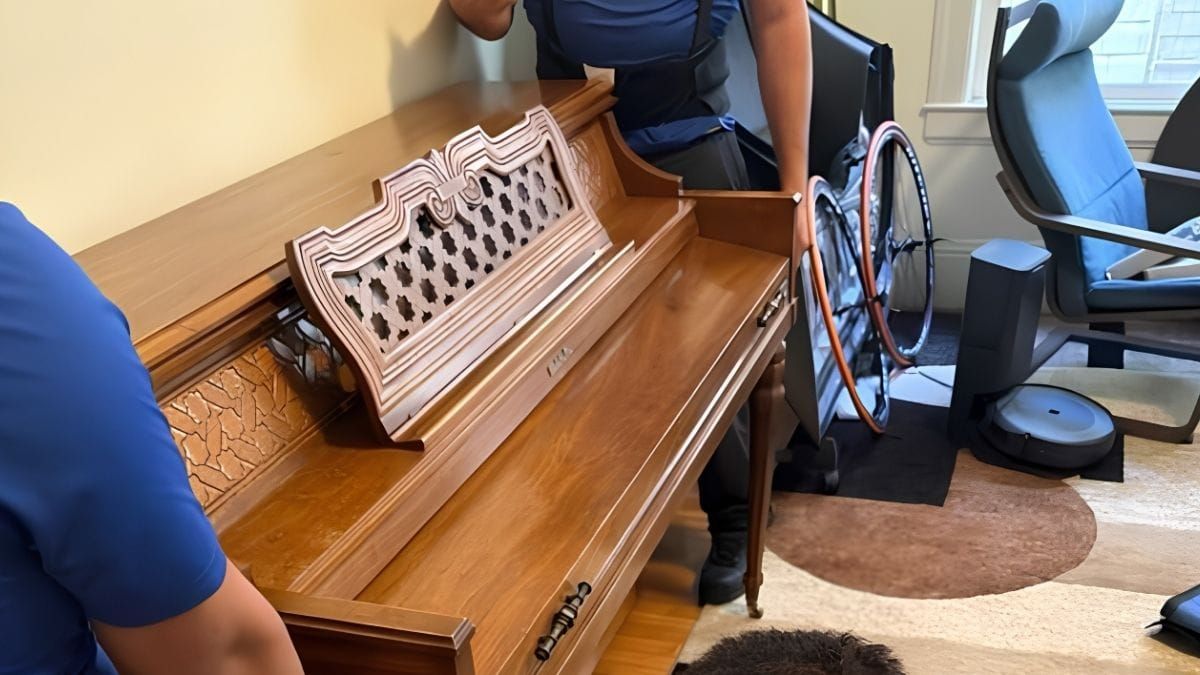
How to move a piano: real costs, risks, and when to hire movers
Most piano moves on Lugg aren't grand pianos — they're uprights and digital keyboards. Here's what it really costs, what'll go wrong, and when to hire help.

A local piano move typically costs $150–$1,000 and almost always requires three to four people. Most pianos in American homes today are uprights or digital keyboards — not the 9-foot concert grand cost guides love to describe. Digital and electronic instruments grew 36.5% in the U.S. over the past decade, including digital pianos (NAMM 2025 Global Report), and uprights have long been the dominant acoustic format. That distinction matters: moving an upright is a different job from moving a grand, and the cost, crew size, and equipment all shift depending on which piano is in your living room.
Pianos are also one of the most consistently underestimated items in a home. They have delicate internal mechanisms, an uneven center of gravity, and a finish that scratches if you look at it wrong — which is why piano moves drive a disproportionate share of moving damage claims industry-wide, according to the American Moving and Storage Association. This guide breaks down what each piano type actually involves, what a fair price looks like, when DIY makes sense, and when to call in help.

Typical Lugg piano move costs by type, with the $120–$340 range covering most local jobs.
Piano types, weights, and costs at a glance
| Piano type | Typical weight | Crew size | Local move cost range | Specialty equipment? |
|---|---|---|---|---|
| Digital / keyboard | 80–300 lbs | 1–2 | $75–$200 | Moving blankets |
| Spinet / console | 200–400 lbs | 3 | $150–$400 | Dolly, straps, blankets |
| Upright | 300–500 lbs | 3–4 | $200–$500 | Dolly, straps, blankets |
| Baby grand | 500–800 lbs | 4 | $400–$800 | Piano board, leg removal |
| Concert grand | 800–1,200 lbs | 4+ (specialty) | $700–$2,000+ | Piano board, climate-controlled truck |
Costs reflect local moves in the U.S. and exclude long-distance transport, storage, or post-move tuning.
Based on hundreds of Lugg piano move bookings through early 2026, a typical upright piano move costs around $210, while a digital piano or keyboard move typically runs around $175. Most jobs fall between $120 and $340, with stairs, distance, weight, and crew size driving the variation.
Why piano moving is harder than it looks
A piano isn't furniture. It's an instrument with internal parts — soundboards, pinblocks, action assemblies — that can crack, warp, or knock out of alignment from a single bad jolt. The exterior cabinet scratches easily, and the cast-iron plate inside makes weight distribution uneven, which is why pianos can't just be tilted onto a hand truck and rolled out the door.
Three things make piano moves uniquely tricky:
Weight distribution. Pianos are top-heavy and front-heavy, so the center of gravity sits in unexpected places. An upright tilted the wrong way can shear its own leg joints. A grand piano lifted by the lid can wreck the lid hinges.
Surface fragility. Most piano cabinets are finished in lacquer or polyester gloss that scratches under bare hands, belt buckles, watch faces, or the edge of a dolly. Wrapping isn't optional.
Internal calibration. A piano's pitch and action are tuned to its position in a room. Even a careful move will require a fresh tuning two to four weeks later, and a bad move can crack the soundboard — a four-figure repair on a four-figure instrument. The same care principles apply to other heavy specialty items, like the ones covered in our guides to moving a hot tub and moving a refrigerator.
Upright pianos: the most common move
Upright pianos weigh 300 to 500 pounds and stand 36 to 60 inches tall. They're the most-moved piano in American homes — about 1 in 4 Lugg piano bookings explicitly involve an upright, more than any other named piano type.
The biggest challenges with an upright are stair access, doorway clearance, and protecting the leg joints. Upright pianos are built to bear weight straight down through the legs, so tilting them sideways during a move puts shear stress on those joints — one of the most common ways an upright cracks during a DIY move. A sturdy dolly, thick moving blankets, and ratchet straps are the baseline kit — required, not optional.
Here's what a real Lugg customer had to say about using Lugg to move a piano up a flight of stairs:
"Alberto and Jorge did a fantastic job! They really went far and beyond to get a piano upstairs. They also helped me move things out of the way and put back in their place before leaving. Excellent guys!" — Hains Tooming, San Francisco Google February 2026)
Digital and electric pianos
Digital pianos are the second-most-common piano on Lugg's platform — Yamaha keyboards, Roland stage pianos, Casio Privia models, and the like. They weigh 80 to 300 pounds, so a single mover or a two-person crew with a pickup or cargo van handles them easily.
The risk with digital pianos isn't weight, it's the electronics inside. A jolt can knock action sensors out of calibration, and the amp and speaker boards are sensitive to impact. Box up the pedal unit and stand separately, wrap the keyboard body in moving blankets, and keep it upright in transit.
Spinet, console, and studio uprights
These are smaller-format upright pianos, typically 36 to 44 inches tall and weighing 200 to 400 pounds. From a moving standpoint they behave like a smaller upright — same fragility, same tilt risk, just less mass. Three people can usually handle them comfortably. Most apartment piano moves on Lugg fall into this category or the standard upright category.
Grand and baby grand pianos
Grand pianos weigh 500 to 1,200 pounds depending on size. A 5-foot baby grand runs about 500 to 600 pounds; a 9-foot concert grand can hit 1,200. Across Lugg's piano bookings, grand pianos appear in less than 4% of jobs — and almost all of those are in-home repositioning rather than long-distance transport.
Moving a grand piano off-property is not a general-mover job. It involves removing the lid, music rack, pedal lyre, and legs, wrapping the body and laying it on a piano board, strapping the board to a four-wheel dolly, and loading the whole assembly into a climate-controlled truck. If your grand piano needs to leave the building, hire a specialty piano mover — companies that move pianos for a living, carry instrument-specific insurance, and have working relationships with piano technicians on the other end.
For room-to-room or carpet-installation-style moves where the grand stays on the property, an on-demand crew with a four-person team and the right protective gear can absolutely handle it.
Here's what a real Lugg customer had to say about using Lugg for an in-home baby grand piano relocation during carpet installation:
"Both crews I used to move my baby grand piano from and back into position after new carpet installation were on time, friendly and efficient." — Bill C., Trustpilot (February 2026)
What piano moving really costs
Piano moves are priced by weight, distance, access difficulty, and crew size. A few real-world reference points:
- Standalone digital piano or keyboard, local move: $75–$200
- Upright piano, single-family home to single-family home, no stairs: $200–$400
- Upright piano, walk-up apartment, 2–3 flights of stairs: $400–$700
- Baby grand, in-home repositioning: $300–$600
- Baby grand, cross-town transport (specialty mover): $400–$800
- Concert grand, cross-country transport (specialty mover): $1,500–$5,000+
Add $100–$200 for a post-move tuning and roughly $50–$150 for climate-controlled storage if your timing doesn't align. If you're working with a full move that happens to include a piano, our guide to moving heavy appliances and large items safely covers the broader logistics.
When DIY can actually work
DIY piano moves work in a narrow set of scenarios. If all of the following are true, you can reasonably consider handling it yourself:
- The piano is a digital, keyboard, spinet, or small upright
- The move is on one level (no stairs)
- The path has standard doorway clearance (30+ inches)
- You have four physically capable people, not three
- You have a sturdy dolly, moving blankets, and ratchet straps (rope and bungee cords don't count)
- The distance is short — same property, or a few miles in a pickup or rented van
Even one missing item flips the math. The NIOSH single-person lift limit is 50 pounds, which means a 400-pound upright requires at least eight lift-units of coordinated capacity — four strong adults working in unison, not three people winging it. The same principles that make a dresser move deceptively hard apply at much higher stakes when there's a piano on the dolly.
DIY upright piano move: step by step
If you're handling an upright DIY move and you've checked the list above, here's the sequence:
1: Clear and measure the path
Measure doorways, hallway widths, and stair landings before you do anything else. Standard interior doors are 30–32 inches wide; an upright averages 24 inches deep. That's tight but workable. Clear the entire path of rugs, shoes, and cords.
2: Remove what you can
Take off the music rack, the bench, and (if applicable) the front fallboard panels. Stash hardware in a labeled bag taped to the back of the piano.
3: Wrap the cabinet
Use heavy moving blankets — not packing paper, not bubble wrap. Cover the entire cabinet and secure with ratchet straps. Straps go around the blankets, not the wood; tape can pull the finish.
4: Position the dolly
A four-wheel dolly goes under the piano with casters parallel to the direction of travel. Two people tilt the piano forward at the top while the third slides the dolly underneath. The piano rests on the dolly through the blankets — never directly.
5: Move slowly, one corner at a time
Assign a corner to each mover and, if available, a fifth person to spot doorways and ceiling fixtures. Move at walking pace. Never rush a piano through a tight space — back up and retry the angle.
6: Load the truck last and unload first
Pianos travel best near the front of the truck, against the cab wall, strapped tight. Load them last so they come out first at the destination, and pad the surrounding load so nothing shifts into them in transit.
When to hire help
Stop and book movers if any of the following apply:
- The piano is a grand or baby grand going off-property
- The route involves more than a single flight of stairs
- You don't have four physically capable people
- The piano is valuable, antique, or sentimentally irreplaceable
- You're not confident in your equipment
For uprights, digital pianos, spinets, and consoles — the formats most people own — an on-demand moving service like Lugg can dispatch a crew with a pickup, van, or box truck the same day, often within 30 minutes, and bring the dollies, blankets, and straps with them. For full grand piano transport off-property, a specialty piano mover is the right call: they have the piano boards, climate-controlled trucks, and tuning networks the job actually requires. Most piano moves cluster in the May–September stretch, so if you're flexible on timing, our guide to the best time to move is worth a look.
If you're parting with an old piano rather than relocating it, the same on-demand options work for piano removal to a donation center, transfer station, or curbside pickup.
Common mistakes to avoid
Tilting an upright sideways to fit through a doorway. This is the #1 way uprights crack during DIY moves. If it doesn't fit upright, you need a different route or fewer items in the doorway.
Using rope or bungee cords instead of ratchet straps. Rope slips, bungees stretch. Neither will hold a 400-pound piano in transit.
Using an underrated dolly. Lightweight utility dollies will fold under piano weight. Whether you're using a four-wheel dolly or a heavy-duty two-wheel hand truck, make sure it's rated for several hundred pounds.
Pushing on the cabinet finish. Push from the bottom corners and base. Hand grease and watch faces will dull a lacquered finish in one move.
Skipping the post-move tuning. Any move will detune a piano. Plan on a tuning two to four weeks later, after the instrument settles into its new humidity environment.
After the move: settling and tuning
Pianos need two to four weeks to acclimate to a new room's temperature and humidity before they can hold a tuning. Schedule a Piano Technicians Guild registered technician for that window — earlier than two weeks and the tuning won't hold; longer than four and the pitch drift gets harder to correct in one visit.
Check the cabinet for new scratches the day of the move and document anything in writing with whoever moved it. Legitimate moving services have a damage claim process, but the window is short.
Frequently asked questions
How many people does it take to move a piano?
Three to four people for an upright or spinet, four for a baby grand, four or more for a concert grand. Digital pianos and keyboards usually need one or two.
Can two people move an upright piano?
Two people cannot safely move a standard upright piano on stairs or through tight spaces. Two strong adults can roll a wrapped upright across one level of flat, unobstructed flooring on a sturdy dolly, but anything more — doorways, thresholds, a single step — requires a third and fourth person to control the tilt and balance.
How much does it cost to move a piano locally?
Based on hundreds of Lugg piano move bookings through early 2026, a typical upright piano move costs around $210, while a digital piano or keyboard move typically runs around $175. Baby grand pianos run $400 to $800 for in-home or short cross-town moves. Costs go up with stairs, weight, distance, and crew size — most jobs fall between $120 and $340.
Why is moving a piano so expensive?
Pianos require more movers, more equipment, and more time than typical furniture. A 400-pound upright needs a sturdy dolly rated for the weight, thick moving blankets, ratchet straps, and three to four people who know how to control a top-heavy load. Pricing reflects both the labor and the risk of damage to the instrument and the home.
Do you need to tune a piano after moving it?
Yes. Pianos detune after any move because the soundboard responds to vibration, temperature, and humidity changes. Wait two to four weeks so the instrument can acclimate to the new environment, then book a registered piano technician. Plan on $100–$200 for the tuning.
How do you move a piano up stairs?
You can move a piano up stairs, but it's the highest-risk piano scenario. A standard upright on stairs requires four movers — two below the piano controlling the load, two above guiding it — plus a stair-rated dolly or skid board. The NIOSH lift limit means stairs effectively double the strength requirement, because at any moment most of the weight is on the downhill movers. If you have more than one flight, hire help.
What's the difference between a piano mover and a regular mover?
Specialty piano movers carry instrument-specific equipment (piano boards, skids, climate-controlled trucks), are insured against soundboard and action damage, and have working relationships with piano technicians for post-move tuning. General on-demand movers handle uprights, digital pianos, and in-home grand piano repositioning well, but cross-town or cross-country grand piano transport is a specialty job.
Will a piano fit in a regular cargo van?
A standard cargo van (roughly 8 feet long, 4 feet wide, 4.5 feet high inside) fits most uprights and all digital pianos and keyboards. Spinet and console pianos fit easily. Full-size studio uprights at the upper end of the range may need a sprinter or box truck. Grand pianos do not fit in a cargo van and require a flatbed or piano-specific truck.
The bottom line
The piano in your living room is probably an upright or a digital — not the 9-foot grand most cost guides describe. Match the crew and equipment to what you actually have, hire help when stairs or off-property grand pianos enter the picture, and plan for a tuning two to four weeks after the move. Ready to book? Lugg piano movers can dispatch a crew with a pickup, van, or box truck the same day.
Holly Benjamin
Holly leads marketing at Lugg and is passionate about making the utilitarian task of moving into something people actually rave about.
Subscribe to the Lugg blog
Get the latest moving tips, guides, and Lugg news delivered to your inbox.
Read more about Lugg loads

What shoppers actually haul home on Black Friday


Bought furniture on Black Friday? How to get it home today

Round Top Antiques Fair: how to shop it and get it home

Where unwanted furniture goes: why mattresses don't get a second life