What cargo vans qualify to drive for Lugg?
Which cargo vans qualify to drive for Lugg, how to tell Lugg Van from Lugg XL, what actually fits inside, and how to get your van activated.

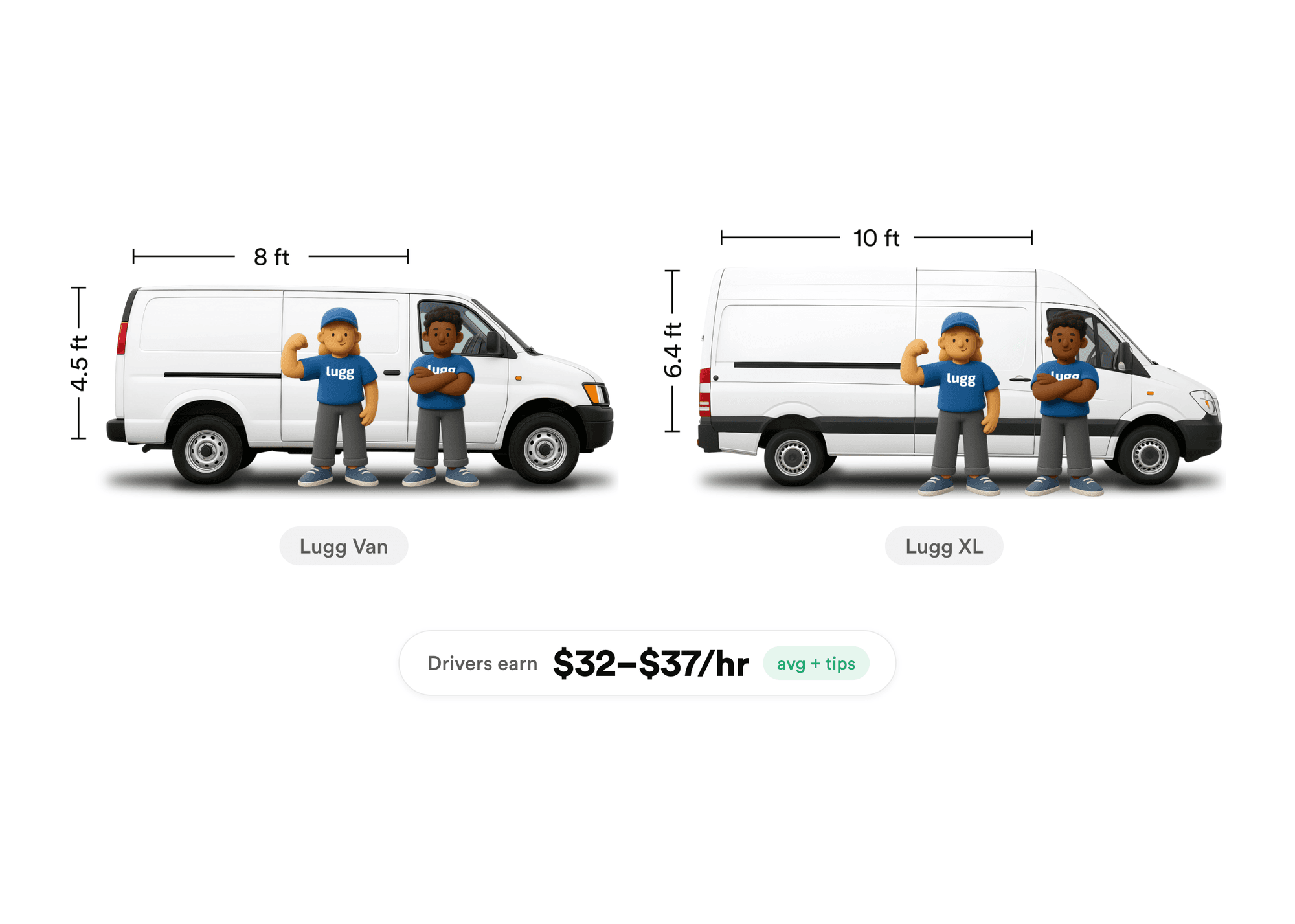
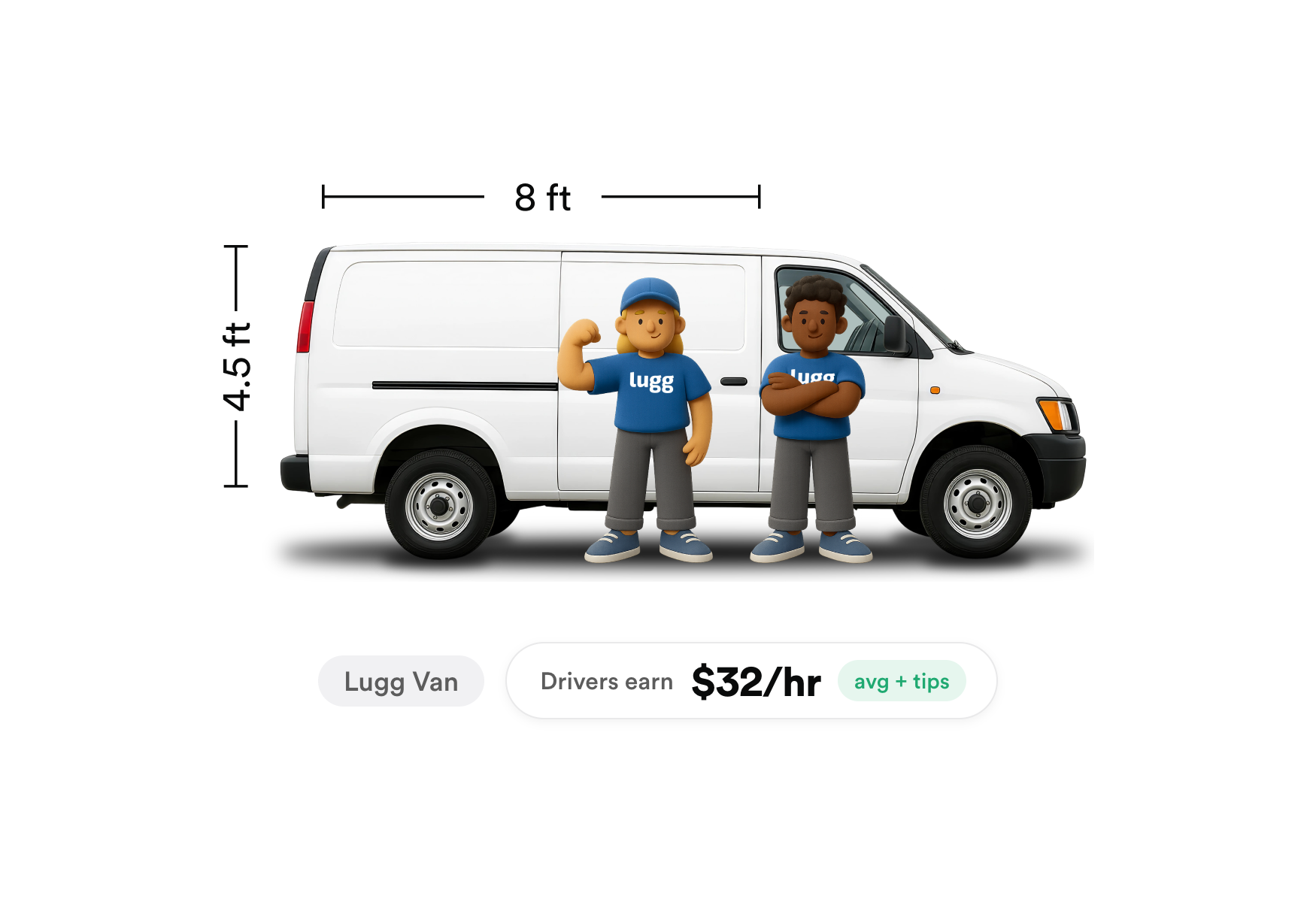
A cargo van qualifies to drive for Lugg if it's a true cargo or sprinter van — not a minivan or passenger van — with an enclosed cargo area at least 8 feet long, 4 feet wide, and 4.5 feet tall, a model year of 2001 or newer, and good cosmetic condition. Full-size vans like the Ford Transit, Ram ProMaster, and Chevy Express clear that bar. A Honda Odyssey or a Dodge Grand Caravan does not.
The thing a cargo van gives you that a pickup can't is a box: enclosed, lockable, and dry no matter the weather. Across more than 1.5 million Lugg moves at a 4.92 out of 5 rating, a steady share are exactly the jobs that space is built for — electronics, boxed furniture, a delivery that has to sit safe between five stops. If you've got a van sitting in the driveway most of the week, here's how to tell whether it earns for Lugg, which tier it runs at, and what actually fits inside.
What are Lugg's cargo van requirements?
Four things decide whether your van is eligible: the type of van, its cargo dimensions, its age, and its condition.
| Requirement | What Lugg looks for |
|---|---|
| Vehicle type | A true cargo van — Ford Transit, Ram ProMaster, Chevy Express, GMC Savana, Nissan NV — not a minivan or passenger van |
| Cargo area (Lugg Van) | At least 8 ft long, 4 ft wide, 4.5 ft tall, enclosed |
| Model year | 2001 or newer |
| Condition | Good cosmetic shape — no significant dents, scratches, or body damage |
| Bigger vans | High-roof or extended vans measuring about 10 ft × 5.5 ft × 6.4 ft or more run as Lugg XL |
| Not eligible | Minivans, passenger vans, SUVs, sedans, hatchbacks |
| Rentals | Allowed in some markets, from specific approved rental companies only — confirm with Lugg operations first |
The van is only half of it. To drive, you also need to be 21 or older, pass a background check, be able to lift 125 pounds safely, have prior furniture-moving experience, carry insurance and registration for the van you'll drive, and have a recent smartphone. Meet those and get your van approved, and Lugg dispatches the work to you during slots you sign up for. You bring the van and basic moving equipment and keep a percentage of each fare, paid the same day you work.
What that adds up to depends on how much you drive. Cargo-van drivers on Lugg take home $32 to $37 an hour on average, plus 100% of their tips, split evenly with your crew. Part-time, that runs about $2,750 to $3,200 a month; at full-time hours it's roughly $5,550 to $6,400 a month — call it $250 to $450 a day, before tips. It's an average that scales with how much you work, not a guarantee: a van you drive a couple of weekends a month and one you run most weeks sit at very different points on that range. Our cargo van driver jobs page has the full pay breakdown by week, month, and year.
Is a minivan a cargo van?
No, and this trips up more people than any other part of the question. A minivan or passenger van doesn't qualify to drive for Lugg, even though it wears the word "van." The rear seats, the contoured floor, and the passenger-first layout are the problem: you can't lay a dresser flat or slide a boxed appliance in without fighting the geometry the way you would in a purpose-built cargo box.
A cargo van is a light commercial vehicle with a flat, open cargo floor behind the front seats and no rear seating — built to carry loads rather than people. That's the distinction Lugg is drawing, and it's the same one most gig platforms and even state commercial-registration rules draw. If your vehicle has a third row, cupholders in the back, and captain's chairs, it's a passenger vehicle, and it won't clear the bar no matter how much it holds with the seats folded down.
Which cargo vans qualify to drive for Lugg?
Most full-size cargo vans qualify. The ones you'll see most on the platform are the Ford Transit, Ram ProMaster, Chevrolet Express, GMC Savana, and Nissan NV — plus, in its taller trims, the Mercedes-Benz Sprinter (and its Freightliner-badged twin). In a regular-roof, regular-length configuration, these typically land in the Lugg Van tier: a cargo van plus two Luggers, sized around an 8-foot-long, 4-foot-wide, 4.5-foot-tall box.
One caution on the small end: the compact cargo vans — the Ford Transit Connect, Ram ProMaster City, and Nissan NV200 — usually fall short of the 8-foot cargo minimum, so measure before you count on one. Same idea as the minivan: the badge says "cargo van," but the box still has to clear the bar.
Which tier your van runs at comes down to measured interior space, not the badge. A high-roof ProMaster and a low-roof Transit are both "cargo vans" on paper and two different Lugg tiers in practice. The bigger and taller the van, the more it can move and the higher it climbs — which is where sprinter and high-roof vans come in.
Does a sprinter or high-roof cargo van qualify to drive for Lugg?
Yes — a sprinter or high-roof cargo van qualifies, and it usually runs as the larger Lugg XL tier rather than a standard Lugg Van. A Mercedes Sprinter is technically the same class of cargo van, just taller and longer, and that extra room is what bumps it up. High-roof or extended vans measuring roughly 10 feet long, 5.5 feet wide, and 6.4 feet tall — the high-roof Sprinter's standing height of about 6 feet 4 inches included — run as Lugg XL.
The vans you'll see most in the XL tier are the high-roof Mercedes-Benz Sprinter (and its Freightliner-badged twin), the high-roof or extended-length Ford Transit, the high-roof Ram ProMaster, and the high-roof Nissan NV. Here's the part that trips people up: the nameplate alone doesn't set the tier. A standard-roof Transit or ProMaster runs as a Lugg Van, and the high-roof, longer version of that same van runs as a Lugg XL. A low-roof Chevrolet Express or GMC Savana stays in the Van tier — those don't come tall enough from the factory to reach XL. Measure the interior before you assume which one you've got.
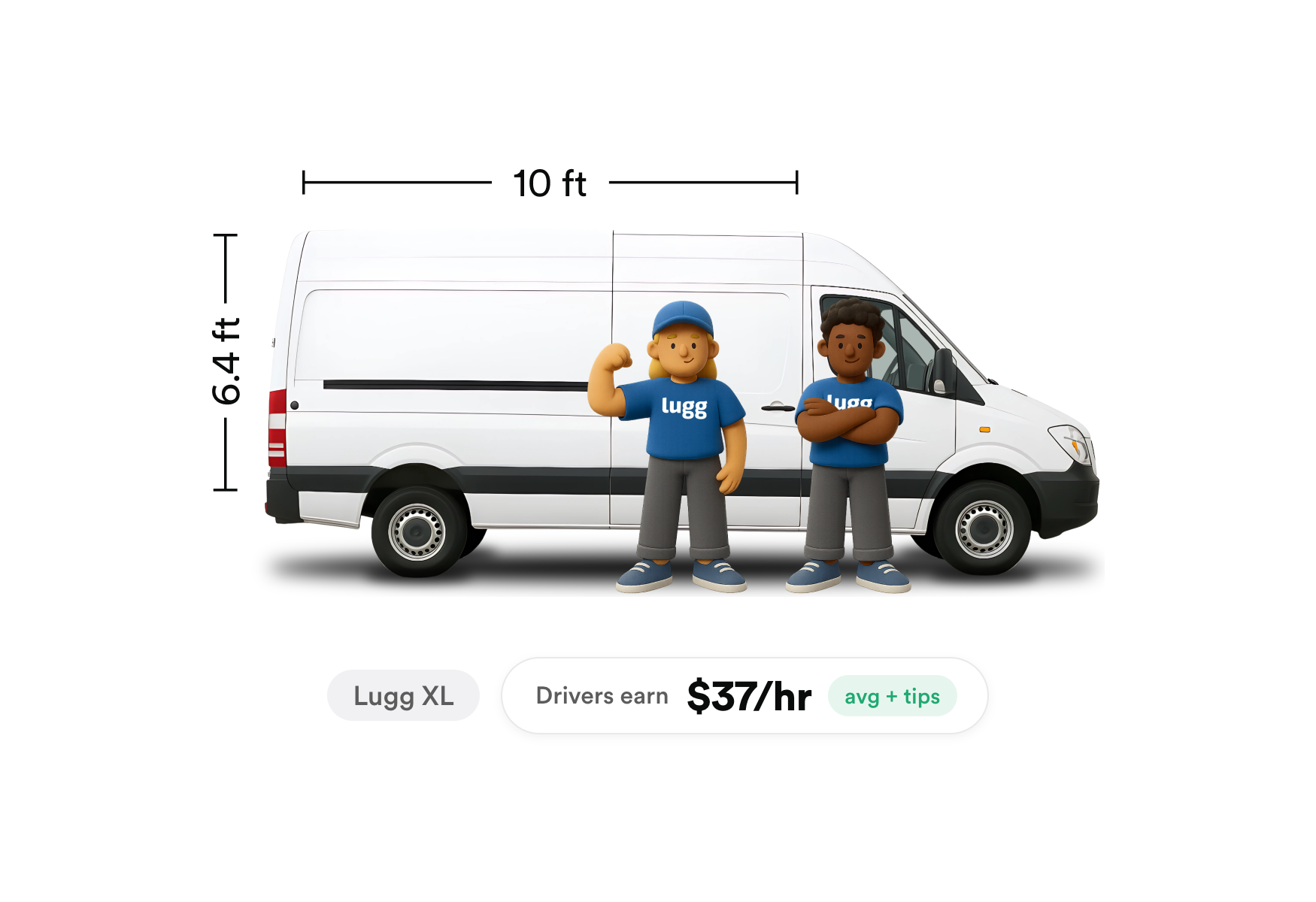
On a van, interior height is the real limiter, the way bed length is on a pickup. A taller ceiling lets you stand loads upright, stack safely, and take tall items a low-roof van has to turn away, so the tier splits on height as much as length:
| Van type | Interior length | Interior height | Lugg tier | Typical pay (on average) |
|---|---|---|---|---|
| Standard / low-roof cargo van | ~8–10 ft | ~4.5 ft | Lugg Van | ~$32/hr |
| High-roof or extended van, incl. Sprinter | ~10+ ft | ~6.4 ft | Lugg XL | ~$37/hr |
Those are each tier's average pay, tips on top; what you actually earn tracks your hours and market, not a promise. A sprinter van driver in the XL tier gets matched to the bigger, taller jobs — and still doesn't need a CDL, since Lugg doesn't require one for vans of any roof height.
What can you fit in a cargo van?
A standard cargo van in the Lugg Van tier handles most single-item and small-load jobs comfortably: dressers, nightstands, boxed furniture, appliances like a washer or dryer, a full or queen mattress, and multi-box deliveries that need to stay dry and out of sight. The enclosed floor and roughly 4.5 feet of interior height let you stack and secure a load in a way an open bed can't.
The clearest limit is width. A king or California king mattress does not fit in the standard Lugg Van — a king runs about 76 inches wide while most cargo vans give you around 67 inches between the walls, so those loads route to a bigger vehicle. Long, rigid items that exceed the cargo length are the other constraint. When a job needs more room than a standard van gives, it goes to a Lugg XL, box truck, or Box+ instead — which is why measuring your real interior box is worth doing before your first slot.
How do you measure a cargo van's cargo space?
Measuring a van is different from measuring a truck bed because you're measuring an enclosed box in three dimensions, and the rear door opening — not the floor — is often the real gate. Empty the van first, then measure the usable cargo space, not the exterior.
1: Measure the cargo length
Run your tape along the floor, from the back of the front seats (or the bulkhead) to the inside of the closed rear doors. That's your true usable length, not the outside of the van.
2: Measure the cargo width
Measure at the narrowest usable point — the gap between the wheel wells — since that's what actually limits a flat load. The space above the wheel wells is wider, but a dresser or mattress has to clear the pinch point down low.
3: Measure the interior height
Measure from the cargo floor straight up to the ceiling at its lowest point. On a standard van that's around 4.5 feet; on a high-roof or Sprinter it can reach about 6.4 feet, which is what bumps it into the Lugg XL tier.
4: Measure the rear door opening
Measure the opening itself, both height and width. An item can fit inside the box and still be impossible to load if it won't clear the doorway, so the opening is often the real limit, not the floor.
Write down all four numbers. If your floor clears 8 feet by 4 feet and your height clears 4.5 feet, you're in the Lugg Van range; if you're pushing 10 feet with a 6-foot-plus ceiling, you're likely a Lugg XL.
Can you drive for Lugg with a rented cargo van?
Yes, but with a specific condition. Lugg allows rental cargo vans in some markets — a common on-ramp for drivers testing the work before they buy — but only from specific approved rental companies, so you'll need to confirm with Lugg's operations team before you count on a rental for your slots. Don't assume any cargo van off any rental lot will be accepted.
One thing you don't need: a commercial driver's license. A standard cargo van is well under the weight class that requires a CDL, so a regular driver's license covers you, same as it does for the rental. If you own the van outright, the math is simpler still — the van earns while it would otherwise sit parked.
What can a cargo van carry that a pickup can't?
A lot of the work overlaps — a loveseat, a dresser, or a few boxes ride fine in an open bed or an enclosed van, and both vehicles handle everything from single-item deliveries to big appliances to full junk removals. Where the van pulls ahead is the loads that have to stay enclosed: electronics and TVs, fragile pieces, artwork, anything that can't ride exposed, and any job on a rainy or windy day. The lockable, weatherproof box lets you keep a load dry and secure the whole route — including across multiple stops — which is real utility on a marketplace where customers book same-day and expect the item to arrive in the shape it left.
The practical upshot: a van covers everything a pickup can carry and adds the enclosed-only loads a pickup has to turn down. If you're weighing which vehicle to run, our breakdown of what pickup trucks qualify for Lugg covers the open-bed side, and the difference between them is mostly the difference between a box and a bed.
Getting your cargo van activated with Lugg
If your van clears the cargo minimums, is a 2001 or newer model in good shape, and it's a true cargo van rather than a passenger van, you're eligible. The sign-up takes about two minutes: you fill out the form, submit your background check, and once it's returned and approved the team activates you — usually within the week. From there you pick up the slots that fit your schedule, and once you pick one up you show up for it. Same-day pay hits after you work.
No cargo van but still want in? You can work as a helper with just a phone and join a two-Lugger crew — the entry bar is lower and you can start while you sort out a vehicle. Either way, sign up to become a Lugger and get your van, or your weekends, earning.
Galina Hyland
Galina leads operations at Lugg, writing about logistics, supply, and what it takes to power same-day moving at scale.
Subscribe to the Lugg blog
Get the latest moving tips, guides, and Lugg news delivered to your inbox.
Read more about Lugg moves

Holiday jobs near me: flexible work through January

Flexible jobs: work the hours you actually have

Weekend jobs near me: how to earn on Saturday and Sunday only

Jobs for college students that work around class
