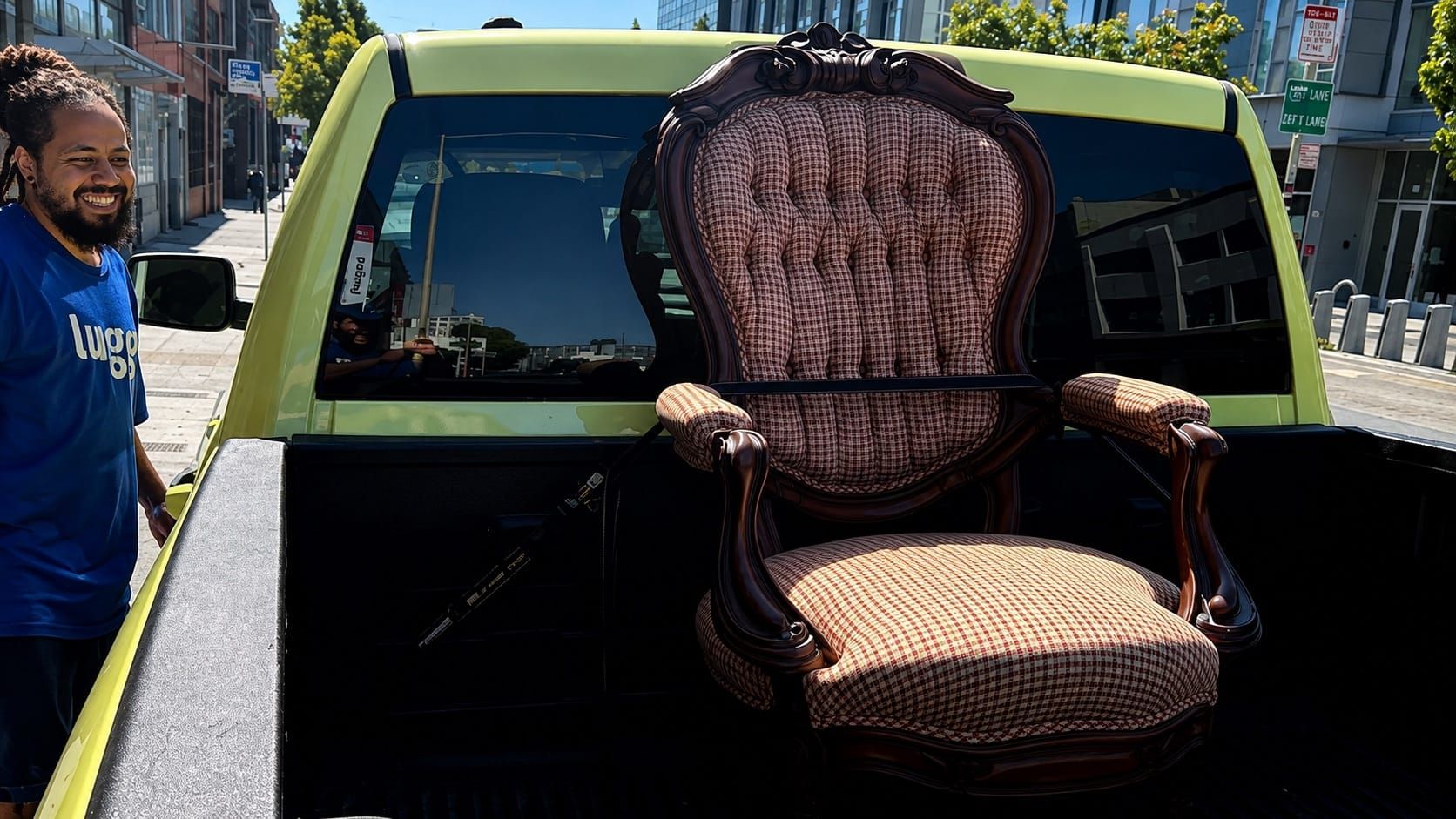
Estate sale furniture: how to get it home before the pickup deadline
Estate sales don't deliver, and the deadline is the buyer's problem. Lugg moves the piece the same day — plus the one question worth asking before you pay.

You paid $85 for the walnut dresser. It's upstairs in a back bedroom, it's heavier than it looks, and the woman running the sale just told you everything has to be out by 2 p.m. Sunday. Read the terms of an estate sale and you'll find language like this: items not picked up by that time are forfeited, and no refunds are issued. Basically, you lose the dresser and you lose the $85.
Estate sales almost never deliver. Removal is the buyer's job, everything sells as-is with all sales final, and the pickup deadline belongs to whoever's running the sale. That leaves four realistic ways home: a friend with a truck, a rental, a courier app that only handles small sealed boxes, or on-demand movers. Across the past year, the median Lugg for an antique or vintage piece ran about $150. Lugg is an on-demand moving and delivery service that picks up furniture from an estate sale and delivers it into your room of choice the same day. Perfect for a piece that has to be out of the house before the sale closes, or one that was never going to fit in your car.
| How you get it home | What it takes | Best when |
|---|---|---|
| A friend with a truck | A free afternoon and a favor you'll owe back | The piece is light and the stairs are short |
| A rental truck | A daily rate plus mileage and fuel | You want the cheapest option and don't mind doing the labor |
| A courier app | Small sealed boxes only, nowhere near furniture weight | You bought lamps and china, not a sideboard |
| On-demand movers | Around $150 for a typical antique or vintage piece | The deadline is today, there are stairs, or you're chaining several sales into one booking |
Do estate sales deliver furniture?
No, estate sales don't deliver furniture — the company runs the sale and clears the house, and moving your purchase isn't part of that. The listing terms usually say so outright: items are sold where-is, buyers arrange their own removal, and the company doesn't move furniture.
There's one courtesy worth knowing about, because it buys you time. Plenty of sales will set a bulky item aside and let you come back for it later the same day, and some will hold it until the next morning. That's discretionary, it varies company by company, and it's the single most valuable question you can ask before you hand over money — not after.
Bigger liquidators sometimes keep a list of local movers near the register, but that's a referral rather than a service — you're still the one booking it, and you're still on the hook for the deadline. Lugg moves estate sale furniture the same day, and the booking stays in your hands.
How long do you actually have to pick it up?
Usually until the end of the sale, which for most estate sales means the last afternoon of the last day. The deadline isn't arbitrary: the company has committed to handing the house back to the family or the realtor on a date, so the clock is real and it doesn't move for you.
Three things to confirm while you're still standing there:
- The exact cutoff — the day and the hour, not "Sunday."
- Whether the piece can be held overnight or into the next morning, and where it'll be put.
- Who's on site to let you in during the pickup window, and how to reach them.
Here's the trap in the way estate sales are priced. Discounts deepen as the sale runs, so the cheapest pieces are the ones you find on the final day — and the final day is exactly when you have the fewest hours to move them. The 75%-off Sunday sideboard is a genuine bargain and the hardest one to collect. If you shop the last day, sort out removal before you start looking.
How do you get a big piece home from an estate sale?
Five things, in this order: confirm the pickup deadline, measure the piece and the route out, pay the sale directly, pick a vehicle sized to the largest item, and get both addresses into the booking. The deadline and the doorway are the two that decide whether the piece can leave the house at all, and both are knowable before you hand over money.
1: Ask about the pickup deadline before you pay
Get the cutoff and the hold policy first, then decide whether you can actually collect the piece. This inverts what most people do, and it's the whole difference between a bargain and a donation to the estate. If the answer is "out by 2 p.m. today" and you have no way to move a dresser, that's useful to know while your money is still in your pocket.
2: Measure the piece and the way out
Measure the piece at its widest point, then measure the route: doorways, the turn at the top of the stairs, the corner from the hallway. Most furniture gets stuck at a turn rather than at the front door, and old houses have tighter turns and narrower stairs than newer ones. Photograph the staircase while you're there so whoever's carrying it isn't seeing it for the first time. If a piece won't make the turn, Lugg movers can take it apart to get it out and put it back together at your place — bed frames, table legs, a dresser with the drawers out. That adds to the time on the job, but it beats leaving the piece behind.
3: Settle up with the sale yourself
Pay the estate sale directly, before anyone comes to collect. Payment methods vary — some companies are still cash or check only, and card payments often carry a processing fee — so check the listing before you go rather than at the register.
4: Pick the vehicle that fits the load
Choose based on the largest piece, not the number of items. A pair of nightstands is a different job from an armoire, and Lugg can move furniture up to 250 lbs per item. If the heaviest thing you bought is a marble-topped washstand, that's what sets the vehicle, even if everything else fits in a tote.
5: Get a real address into the booking
Estate sales publish the house address on the listing, which makes this easier than a private sale where the seller won't share one. Enter the pickup and drop-off addresses, and you'll see your upfront estimate before you book anything — the number is built from the distance between the two addresses, so it doesn't change because traffic was bad.
Shopping more than one sale in a day
The estate sale circuit is a weekend habit, and three houses in an afternoon is a normal Saturday. It also means three separate deadlines, set by three different companies, none of whom coordinated with each other.
Sequence the route by cutoff rather than by distance. The earliest deadline is the one that binds, even if that house is the furthest away, and a route planned around mileage is how the good piece gets stranded at the sale that closed at noon. Write the three cutoffs down before you leave the first house.
One booking can chain the pickups — up to five stops, so a run through three sales and home is a single job rather than three. That's cheaper than three trips and, more usefully, it's one arrival window to plan around instead of three.
What does it cost to have someone move an estate sale piece?
Around $150 for a typical antique or vintage piece. Across Lugg's last twelve months the middle of the range ran roughly $105 to $230, depending on the size of the piece and how far it's going.
What moves that number is the size of the load and the time on the job, because labor is priced by the minute with no hourly minimums. That matters more at an estate sale than it looks: traditional movers commonly bill a two-to-four hour minimum, which is a poor fit for one dresser coming out of one bedroom.
Lugg is an on-demand moving and delivery service that moves estate sale purchases within the hour, or on a date scheduled up to 60 days ahead. Because estate sales are listed days in advance, you can book the pickup before you've even seen the house. Every booking is covered by the Damage Protection Guarantee, which is worth more here than on a new-furniture delivery — a scratch on a reproduction sideboard is a nuisance, and a scratch on a 1920s one isn't fixable.
For a sense of how this works at scale: Lugg ran on-site same-day delivery for shoppers at Sylvie's antique estate sale, moving French farmhouse tables and 18th-century sideboards out of a warehouse sale and into people's homes across two weekends.
Cash-only sales, and why you have to settle up yourself
This is the one that surprises people who book a mover and then don't show up: the movers can't pay the seller on your behalf. If the sale is cash-only and you're not there, the piece doesn't leave the house. So either pay in full before the crew arrives, or plan to be on site when they do.
The crew will also look the piece over when they get there. That's genuinely useful on secondhand furniture — a loose leg or a cracked mirror is better found in the driveway than in your living room — but it does add to the time on the job. The way to keep it short is to inspect the piece properly yourself while you're at the sale, and to photograph any damage you're accepting. Everything is sold as-is, so once you've paid, condition is your problem. The same discipline applies to anything secondhand; it's the same care you'd take buying used furniture from a private seller.
Getting the walnut dresser out of the back bedroom
The dresser was never the hard part. The hard part is a specific bedroom, a specific staircase and a specific hour on Sunday, and all three are knowable before you pay for it.
If the deadline's today and the piece is bigger than your back seat, book estate sale delivery through Lugg — you'll see the estimate before you commit, and the dresser ends up in the room you want it in instead of your driveway.
Loren Couse
Loren manages Growth and Online Strategy at Lugg. With a deep passion for consumer technology, he stays on the cutting edge of the latest digital trends. When he isn’t strategizing, he spends his free time building personal coding projects.
Subscribe to the Lugg blog
Get the latest moving tips, guides, and Lugg news delivered to your inbox.
Read more about Lugg deliveries

Round Top Antiques Fair: how to shop it and get it home


Country Living Fair 2026: A Shopper's Guide to Rhinebeck

The best places to buy furniture in Boston: outlets, flea markets, and curb finds
Cheap furniture near me: where to find the best deals (and get them home)