
How to plan a stress-free college dorm move-in (2026 Checklist)
Move-in day is the most chaotic 48 hours of freshman year. Here's how to time your arrival, pack smart, and get it all upstairs without the stress.

The smoothest college dorm move-ins come down to three things: arriving during your assigned time slot, packing less than you think you need, and having a plan to get everything upstairs fast. It's a rite of passage at scale — about 1.9 million recent high school graduates head straight to college each fall (62% of the class, according to the National Center for Education Statistics), and move-in is the first big logistical test for many of them. It's also an expensive day: the National Retail Federation reported that families planned to spend an average of $1,325.85 on back-to-college shopping in 2025. With that much money, emotion, and cardboard riding on a single afternoon, a little planning goes a long way.
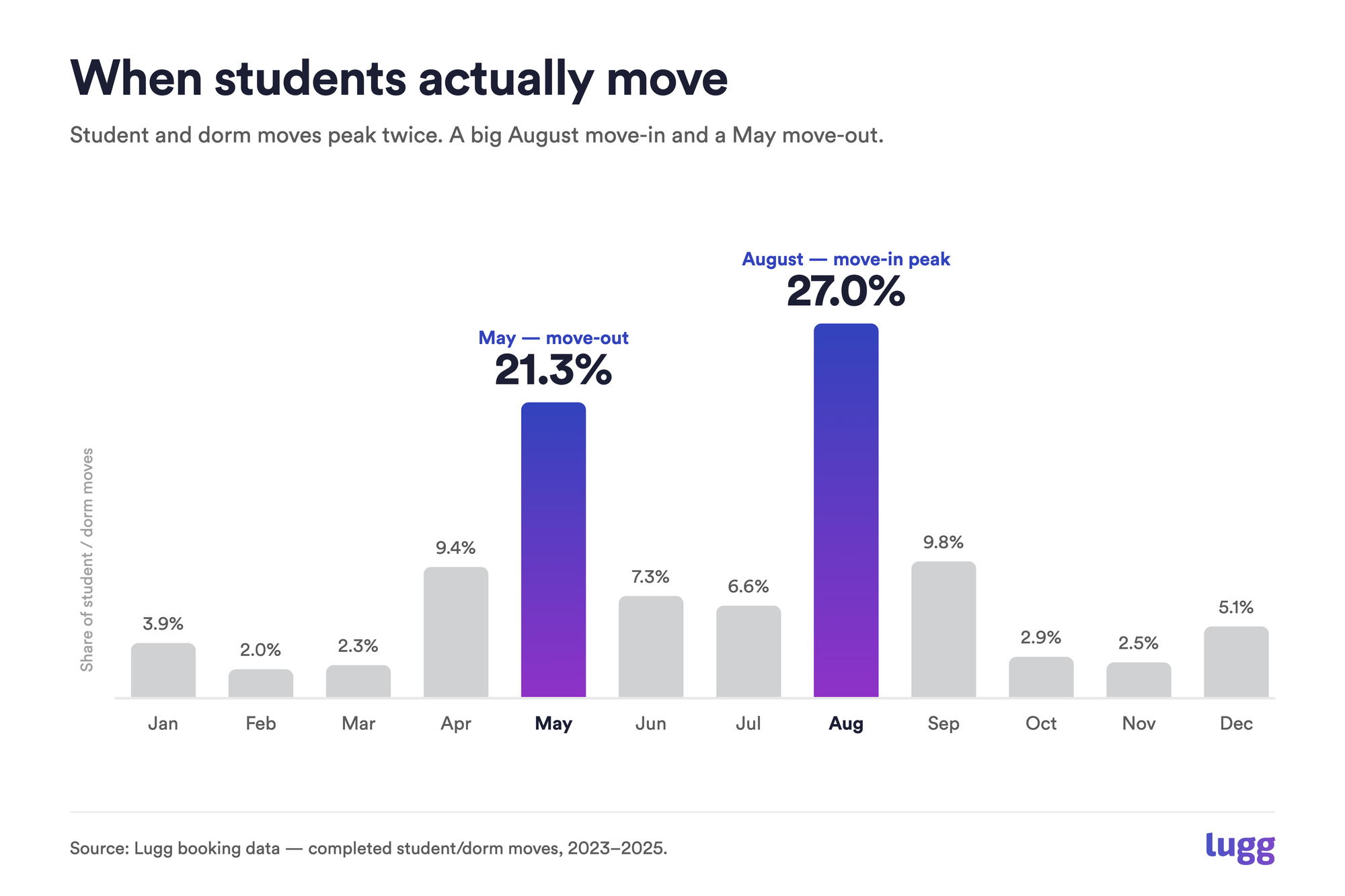
Timing also matters, sometimes just as much as money. August is the single busiest month of the year for student and dorm moves on the on-demand moving platform (2023-2025 Lugg data), accounting for roughly one in four to one in three of them — so move-in day means competing for elevators, parking, and movers with everyone else who picked the same day.
This guide covers exactly when to arrive, what to bring and what to skip, how to move it all in without a backache, and how to keep the day calm, for both students and parents alike.
Start by reading your housing assignment closely
Before buying or packing anything, read your housing assignment and move-in instructions in full. Most colleges assign each student a specific move-in date and time window to stagger traffic, and many tell you exactly what's already in the room, which is typically a bed frame, mattress, and a desk.
Knowing what's provided keeps you from hauling furniture you don't need. The notice also usually lists prohibited items, which vary by school but commonly include candles, halogen lamps, space heaters, hot plates, and extension cords without surge protection. Bringing banned gear only to have it confiscated at the door is a classic move-in day frustration.
Two numbers are worth writing down before you shop: the mattress size (almost always twin XL) and the room's rough dimensions. A tape measure and your room layout will save you from a too-big futon or a rug that doesn't fit.
Pack for a dorm, not a house
The single most common move-in mistake is overpacking. A dorm room is small, shared space with little storage room available. The goal should be to bring what you'll use in the first few weeks, not everything you might want all year. You can always ship stuff later, or pick up more items during winter break.
A realistic dorm essentials list looks like this:
- Bedding: twin XL sheets, a comforter, a mattress topper, and two pillows
- Bath: a towel set, a shower caddy, and shower shoes for shared bathrooms
- Storage: under-bed bins, a few collapsible cubes, and slim hangers
- Tech: laptop, chargers, a power strip with surge protection, and an extension cord if allowed
- Daily life: a small first-aid kit, basic cleaning wipes, a laundry hamper, and detergent
- Comfort: a desk lamp, a small fan, and a few photos or posters
And the things to leave at home: a printer (the library has one), out-of-season clothing, bulky furniture before you've seen the room, and most kitchen gear beyond a mug and a water bottle. If you're unsure about an item, leave it.
Coordinate with your roommate before you buy anything
The mini-fridge is the signature dorm purchase, but message your roommate before move-in to coordinate the big shared items. The other obvious things to divide are a microwave, a rug, and any shared electronics like a TV or a small speaker.
A five-minute conversation also sets early expectations on the less glamorous stuff: who's bringing cleaning supplies, how you'll handle the trash, and whether you want a shared or separate setup.
Plan how you'll actually get everything upstairs
The part most families underestimate is the physical move itself: carrying everything from a far-off parking lot, up crowded stairs or a single slow elevator, into a room down the hall on the fourth floor.
A few strategies that make a real difference:
- Pack in stackable bins, labeled boxes, or reusable storage bags that load and carry far more efficiently.
- Bring or rent a folding hand cart. Many dorms loan a limited number of carts on move-in day, and they go fast, so having your own can make all the difference.
- Lift smart. For any heavy, bulky, or oversized items, ensure 2 people are lifting. There’s nothing worse than a pulled back in the middle of move-in day.
- Consider hiring help. For families flying in, arriving without a vehicle, or facing a walk-up with no elevator, hiring professional movers or labor-only movers, even for a short time, can turn an all-day ordeal into just a couple of hours. On-demand and same-day moving services have made this far easier to book last minute than it used to be.
If you're moving a student out of one dorm and into another, the same rules apply in reverse, and an empty room inspection usually has a hard deadline, so build in buffer time.
Time your arrival to beat the crowd and the heat
Arrive at the very start of your assigned window rather than the middle of the day. The first hour of a move-in slot is almost always calmer than the midday rush, when elevators back up and the closest parking disappears.
Move-in lands squarely in the summer moving rush and student moves cluster even tighter, with August alone accounting for about a quarter to a third of all student and dorm moves on a major on-demand platform. Late-August move-in days can also be brutally hot, so pack a cooler with water, wear breathable clothes, and take breaks. Heat exhaustion is a real and avoidable way to ruin day one.
For parents: what actually helps (and what doesn't)
The most useful thing a parent can do on move-in day is handle logistics so the student can focus on the room and the new people in it. That means driving, navigating parking, managing the cart runs, and keeping everyone fed and hydrated. It’s the invisible labor that keeps the day moving smoothly.
Research on the college transition links over-involved “helicopter” parenting to a harder first semester: a 2024 study in the Journal of Social and Personal Relationships found that controlling parenting frustrated students' sense of competence and autonomy, which in turn weakened their academic and social adjustment. On move-in day, resist the urge to deep-clean or fully unpack the room yourself, and let your student problem-solve the small stuff. Students settle in faster when the space — and the decisions — already feel like theirs.
Student-affairs staff often describe the parent's job as shifting from director to consultant. Only available when genuinely needed, not running the show. The most useful prep happens before the car is even packed: making sure your student can do their own laundry, book a doctor's appointment, manage a debit card, and refill a prescription. Those everyday skills do more for a smooth first month than anything you can carry up the stairs.
Plan the goodbye, too. Drawn-out departures tend to be harder than short, warm ones. Homesickness is normal and usually temporary — a longitudinal study in the journal Emotion found it's common among first-year students and tends to ease over the first semester, though those with more intense homesickness had a tougher overall adjustment. Steady but not constant contact — a regular weekly call rather than all-day texting — gives a new student room to build a life on campus. Many student-life offices schedule a first-day event right after move-in, precisely as a cue for families to head out. Say what you want to say, then let them step into their new chapter.
Don't forget about move-out
The smartest move-in planning also looks ahead to move-out, because spring departure is its own scramble. It’s happening during finals, on a tight deadline, with a room inspection at the end. If the student is staying in the area, a small storage unit over the summer can be cheaper and far less stressful than hauling everything home and back. Booking movers or storage early in the spring beats the end-of-semester rush, when both are in highest demand.
What move-in day really comes down to
A good dorm move-in isn't about the perfect setup or the fullest carload. It comes down to three things: arriving on time, bringing what you'll actually use, and having a plan to get it all upstairs. Read your housing assignment, pack light, coordinate with your roommate, and aim for the calm start of your window. Do that, and the hardest part of the day will just be the goodbye.
Morenike Olufemi
Morenike is a content creator at Lugg, passionate about moving and making spaces feel personal. Her dream interior design is inspired by Parisian charm and maximalist flair. In her free time, she enjoys coffee, croissants, and strolling downtown.
Subscribe to the Lugg blog
Get the latest moving tips, guides, and Lugg news delivered to your inbox.
Read more about Lugg moves

Back-to-School Storage: A University Partnership Playbook for Storage Operators

Where to store your dorm stuff over the summer (and how to actually get it there)

Lugg vs Dolly vs Taskrabbit: which should you use?
Back-to-school moving tips for a smooth dorm move in