
How much does a moving company cost? How to read your quote
Two movers can quote the same move hundreds apart. Here's how to read a moving company quote — and make sure the price you're told is the price you pay.

A moving company quote is rarely a single number — it's a stack of parts, and the total depends as much on how the company prices as on what you're moving. A local move averages around $1,250 (American Moving and Storage Association), but two companies can quote the same move hundreds of dollars apart because one bills by the hour, one charges a flat rate, and one buries the difference in add-ons. Before you sign anything, here's how to read a moving quote line by line — so the number you're told is the number you pay.
The four ways moving companies price a move
Moving companies quote in one of four ways, and knowing which one you're looking at tells you where the cost can move.
- Hourly — crew size × hourly rate × hours, with a 2–4 hour minimum. Used for most local moves; watch the clock, since slow days and stairs run up the total.
- Flat rate — one fixed price for the whole job. Common for some local jobs and store delivery; check what counts as "extra" outside the flat.
- Weight + distance — shipment weight × a per-mile rate. Used for out-of-area moves only, where the final weigh-in can exceed the estimate.
- Truck size + per minute — a base price by vehicle plus labor billed by the minute, no minimum. Used by on-demand services like Lugg; the main thing to get right is booking the right-size truck for your load.
For a traditional local move, you'll almost always get an hourly quote: in 2026, a two-mover crew with a truck runs $105–$165 per hour nationally, and $160–$230 in metros like New York, NY and San Francisco, CA. The catch is that an hourly quote isn't a price — it's a rate with a minimum attached. Your total isn't known until the job's done, and a 2–4 hour minimum means a 45-minute job can still bill like half a day.
Per-minute pricing works on the same idea — your time still costs money — but drops the minimum. With a service like Lugg, the cost is the truck size you book plus labor billed by the minute, so you pay for the actual time the move takes instead of a rounded-up block. That works in both directions: a quick couch lift is billed as a quick couch lift, and a full-house move is billed for exactly the hours it runs. You also pick the vehicle that fits the load — a studio might need a Lugg Van or XL, a two-bedroom a Lugg Box or Box+ — so you're not paying for space you don't use. It's also worth seeing how on-demand pricing compares to traditional movers.
Will the price hold? Binding vs. transparent pricing
What actually protects your budget isn't a particular contract — it's a price you can trust. That comes two ways: a binding estimate that locks the total, or transparent pricing where you only pay for the actual time and service at a rate you saw up front.
- Binding estimate — a locked-in total the mover commits to regardless of final hours or weight. Common on larger van-line moves.
- Transparent per-minute pricing — no locked total, but no surprises either: a fixed, visible rate, no surge, no hidden fees, billed only for the actual time. It's the model on-demand services like Lugg use, and for a local move it's often the most predictable of the three.
- Non-binding estimate — the one to watch. It's an educated guess that can legally climb to 110% of the estimate at delivery, and a lowball number from a company that pads the bill is where people get burned.
Whichever you're quoted, the test is the same: can you trust the number you were shown? If yes, the label matters less than the transparency behind it.
How to decode the line items
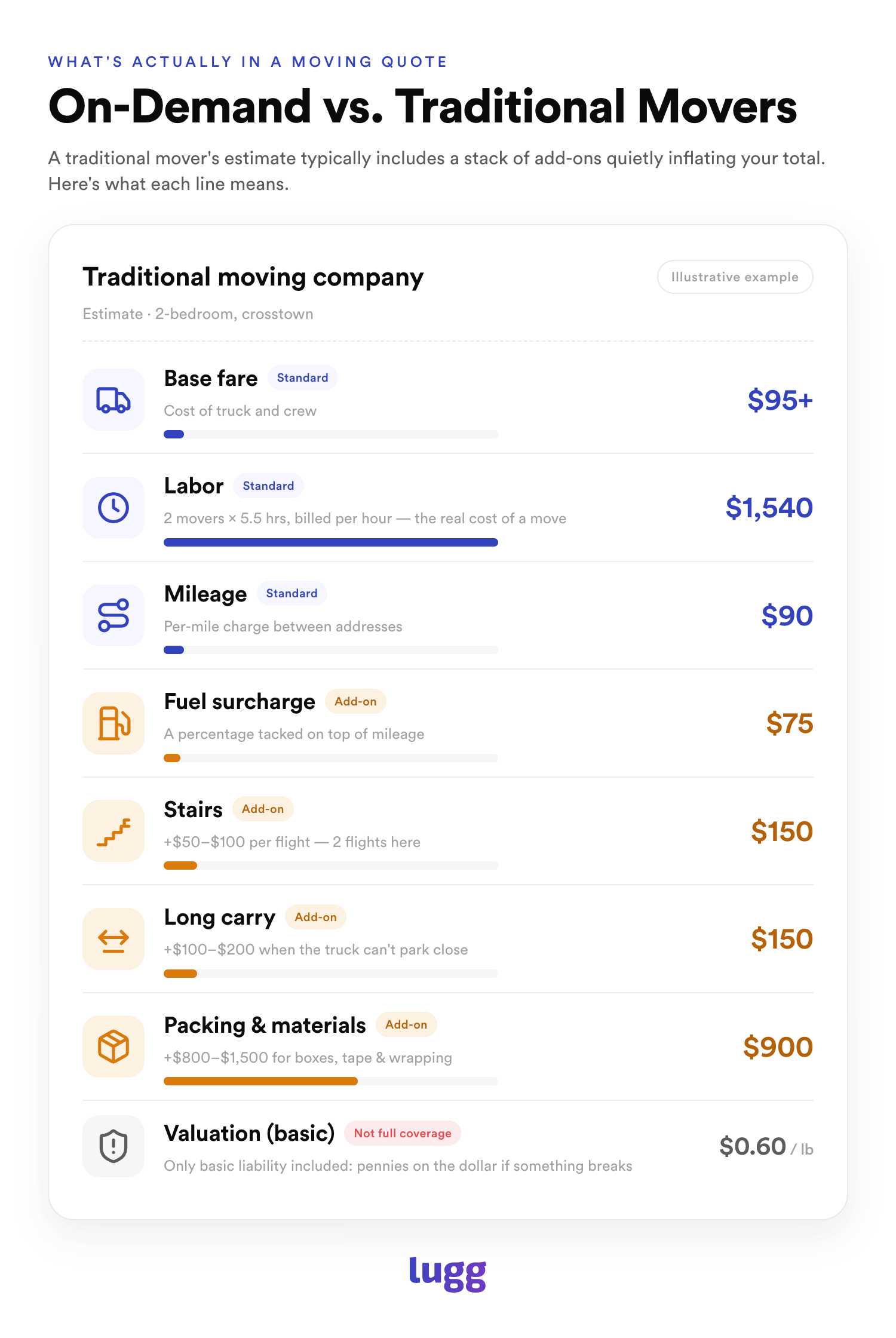
Once you have a written estimate, the line items tell you what's actually included — and what's waiting to be added. Here's what each common charge means.
- Base fare / trip charge. A flat starting cost that covers the truck showing up. Usually non-negotiable.
- Labor. The biggest piece of a local move — typically 60–70% of the bill. Billed hourly or per minute.
- Mileage or fuel. A per-mile charge between addresses, or a flat fuel surcharge. Small on local moves, much larger on out-of-area ones.
- Stairs. Many movers add $50–$100 per flight when there's no elevator. (Worth asking up front — some on-demand services, Lugg among them, don't charge for stairs at all.)
- Long carry. If the truck can't park within ~75 feet of your door, some moving companies will charge $100–$200.
- Packing and materials. Full packing for a three-bedroom home runs $800–$1,500 in labor and boxes. If your quote looks low, check whether packing is in it or not.
- Valuation (not insurance). Standard "released value protection" reimburses just $0.60 per pound for damaged items — not a typo. Fuller coverage costs about 1% of your belongings' value. On-demand moves are handled differently: every Lugg move is covered by the Damage Protection Guarantee at no extra cost.
The gap between a clean quoted number and a messy final invoice almost always lives in these add-on lines. A quote that lists them is honest; a quote that hides them is the one that surprises you.
Red flags that mean the quote will grow
Some quotes are built to look low and climb later. Watch for these before you book:
- A binding-sounding total promised sight-unseen. For anything bigger than a studio, a traditional mover needs a walkthrough to stand behind a binding number — a guaranteed total over the phone is often a lowball that climbs. Transparent per-minute services are different: you can get an instant estimate because you only pay for the actual time and service.
- A large upfront deposit. Reputable local movers rarely need much, if anything, before the job. Authorization holds are different, since you aren't actually charged until after your move is complete.
- No written estimate. If it's not in writing, it isn't a quote — it's a sales pitch.
How to compare two moving quotes fairly
The mistake most people make is comparing the bottom-line numbers. Compare the structure instead:
- Match the estimate type. A binding $1,400 can easily beat a non-binding $1,200. Line them up on the same terms.
- Check what's included. One quote with packing and one without aren't the same move. Read the line items, not the total.
- Add the variables. Stairs, long carry, and minimums hit differently by company. A walk-up apartment changes the math.
- Ask how the final bill is calculated. If a company quotes one way and bills another, that's where surprises live.
If you'd rather skip the quote-decoding entirely, that's the case for on-demand pricing. Booking local movers through a service like Lugg gives you an upfront estimate — a clear range of what most customers pay for a job like yours — with no hourly minimum, no stairs fee, and no surge pricing. For apartment-sized moves especially, an apartment moving service priced by truck size and per-minute labor takes the guesswork out of the part of moving most people dread. (Want ballpark numbers before you even get an estimate? Our moving cost calculator post lays out real average prices by move size.)
Frequently asked questions
Can you negotiate a moving company quote?
Often, yes — especially in the off-season. Ask a company to match a competitor's binding quote, waive a travel or fuel fee, or drop the rate for a mid-week date. Negotiation works best when you have a written estimate from another mover to point to.
How long is a moving quote good for?
Most moving quotes are valid for 30 to 60 days, but the rate can change if your date lands in peak season (May–September) or your inventory grows. Lock in a binding estimate close to your move date, and get a fresh quote if more than a month passes.
Does a moving company quote include a tip?
No — tips are separate and never built into a written quote. For movers who do a good job, 15–20% of the labor cost, or $20–$40 per mover, is customary. Here's a fuller breakdown of how much to tip your movers.
Read the structure, not the total
A moving company quote isn't one number — it's a pricing model, an estimate type, and a stack of line items, and the cheapest-looking quote often isn't the cheapest move. Read the structure before the total, and always ask whether the price is binding. If you'd rather skip the quote games and start from a clear upfront estimate, Lugg books on-demand movers and a truck in real time — priced by truck size and per-minute labor, with no hourly minimums and no charge for stairs.
Holly Benjamin
Holly leads marketing at Lugg and is passionate about making the utilitarian task of moving into something people actually rave about.
Subscribe to the Lugg blog
Get the latest moving tips, guides, and Lugg news delivered to your inbox.
Read more about Lugg moves

How to Find Free Moving Boxes (and How Many You Need)

Where unwanted furniture goes: why mattresses don't get a second life

Moving to Salt Lake City: where to live along the Wasatch Front

Moving to Las Vegas: where to live across the valley
