
Amazon driver jobs in 2026: DSP, Flex, and what each pays
Amazon says Flex drivers earn $18–$25/hr. After gas and wear? Closer to $12. Here's the real pay picture, and the gig paths clearing $40+/hr.

Amazon driver jobs in 2026 fall into two main paths: driving for an Amazon-contracted Delivery Service Partner (DSP) as a W-2 employee, or picking up blocks as a 1099 independent contractor through Amazon Flex. DSP drivers average around $19.80 per hour, according to Indeed's April 2026 wage data, and use an Amazon-branded van on a set schedule. Flex drivers use their own vehicle and earn $18–$25 per hour, per Amazon's own figures, choosing when and where they work. Lugg is an on-demand moving app that pays drivers about $28–$47 an hour depending on vehicle, plus tips — a local alternative to Amazon DSP and Flex for drivers who own a pickup, cargo van, or box truck and don't want a CDL or a fixed delivery route.
For broader context, the U.S. Bureau of Labor Statistics reported a median annual wage of $44,140 for light truck drivers as of May 2024, with 8% projected job growth for delivery drivers through 2034 — faster than the average occupation. Both Amazon paths come with real tradeoffs worth understanding before you commit — capped pay ceilings on DSP, vehicle wear and block scarcity on Flex. Platforms like Lugg work differently: if you own a truck or van, you'll often earn more per hour than either Amazon path; if you don't own a vehicle, you can still earn as a helper with uncapped tips and more schedule flexibility than either Amazon role.
Quick comparison: the driver paths at a glance
| Path | Employment | Vehicle | Avg. pay | Schedule |
|---|---|---|---|---|
| Amazon DSP | W-2 employee | Provided van | $18–$22/hr | Set 4–5 day shifts |
| Amazon Flex | 1099 contractor | Your own car | $18–$25/hr | You pick “blocks” |
| Lugg | 1099 contractor | Your own truck/van | $28–$47/hr | You pick slots and work when you want |
Amazon pays for packages, regardless of what you drive. Vehicle-based moving platforms pay for the size of the job — which is why a pickup or box truck earns substantially more per hour on a platform like Lugg than on Amazon Flex, even with identical vehicle costs.
No truck? You can still earn as a helper — just a phone and the ability to lift.
Amazon DSP at a glance
DSP is Amazon's W-2 employee path. You work for an independent small business contracted by Amazon, driving a company-provided van on pre-planned routes out of a delivery station. Average pay is around $19.80/hour per Indeed's April 2026 wage data, with health, dental, and 401k benefits at most partners and no personal vehicle costs. The tradeoff is a capped ceiling: ZipRecruiter reports top DSP earners (90th percentile) top out around $66,000 annually, and drivers routinely handle 200+ packages across 150+ stops in a 10-hour shift. Most vans also run AI-powered cameras monitoring driving behavior, which factors into performance scores. It's steady work, but there's little room to scale your earnings regardless of how hard you run your route.
Amazon Flex at a glance
Amazon Flex is the 1099 contractor path. You sign up through the Flex app, reserve delivery blocks (typically 2–6 hours), pick up packages at an Amazon warehouse or Whole Foods location, and deliver in your own vehicle. Amazon states most Flex drivers earn $18–$25/hour, paid twice a week. The catch: that figure is before vehicle costs. After gas, maintenance, insurance, and depreciation — the IRS standard mileage rate sits at 70¢/mile for 2025 — many drivers report effective earnings closer to $12–$18/hour. Blocks in competitive markets also get claimed within seconds of release, meaning "flexibility" often translates to hours of refreshing the app just to get any work at all. And there's no safety net: no health insurance, no PTO, and a full 1099 tax burden on you.
When Amazon driver jobs aren't the right fit — and what else pays if you have a vehicle
Here's the fundamental problem with both Amazon paths: your earning ceiling is set by Amazon, not by you or your vehicle. DSP caps out around $22/hour regardless of how efficiently you run your route. Flex pays roughly the same rate whether you're driving a Civic or a cargo van, even though a cargo van can handle jobs paying three times more elsewhere. If you have a pickup, Sprinter, or box truck, you're leaving real earning potential on the table every day you clock in for Amazon.
That's where vehicle-based gig moving platforms come in. These platforms connect independent contractors who own their own vehicles with customers who need help moving furniture, appliances, or large items — the kind of loads Amazon Flex structurally can't take on. Pay scales with vehicle size, not package count.
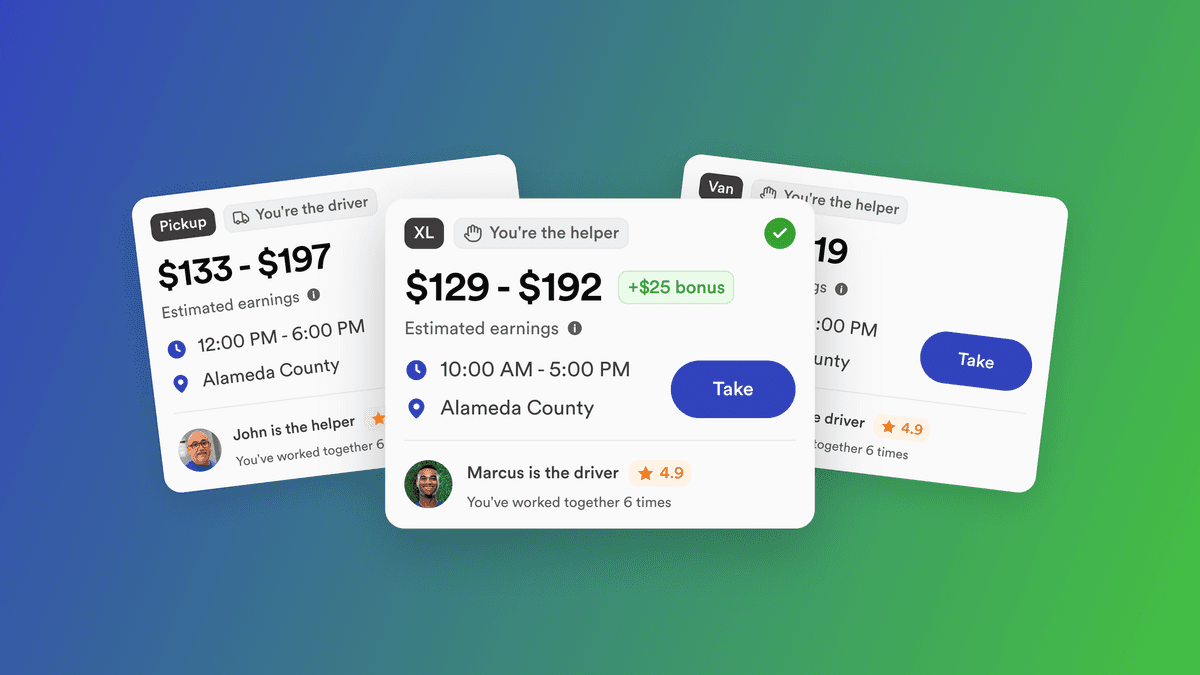
Lugg is an on-demand moving and delivery marketplace, and Luggers — the 1099 drivers and helpers on the platform — pick up the slots they want, the way Flex drivers reserve blocks. The earning ceiling is where the two models diverge. According to Lugg's 2026 platform data, average hourly earnings start at $18/hour for helpers (no vehicle needed) and climb to $42/hour for box truck drivers — and those are cross-market averages, so earnings in stronger markets run higher. Pay is commission-based (per-minute labor plus a base fare), which means Luggers who move quickly earn more than the averages suggest, and tips are uncapped on every move — top earners pull $1,000+/month in tips alone. That's a ceiling neither Amazon path comes close to.
A few differences that matter if you're comparing Lugg against Flex:
- Daily pay, not Tuesday/Friday. Luggers get paid at the end of every day they work.
- No block scramble. You pick up your own slots — from 30-minute deliveries to 10-hour days — with no refresh-to-reserve competition.
- Your vehicle earns what it's worth. A box truck averages ~$42/hour on the platform versus the same $18–$25/hour range Flex pays regardless of vehicle size. Pay scales with the job, because the jobs do.
- Uncapped tips across every move. Top-earning Luggers pull $1,000+/month in tips alone — and unlike Flex, tips are standard on every move, not just Amazon Fresh or Whole Foods runs.
Starting is simple: to drive you need a qualifying pickup truck, cargo van, or box truck (2001+, insured in your own name) and basic moving equipment; to help as a Moving Helper, just a phone and the ability to lift. Drivers must be 21+ (helpers 18+). A background check is required, and it's paid by the Lugger — the cost comes out of your future earnings rather than an upfront charge, and no CDL is required for any Lugg vehicle class.
Not sure whether your vehicle makes the cut? Pickup trucks that qualify for Lugg and cargo vans that qualify list the year, bed, and door requirements Lugg actually checks.
Here's how one Lugger put it in a January 2026 App Store review:
“Lugg offers flexibility without the wear and tear on your car. It's another way of making money similar to Lyft and Uber — but you're moving furniture instead of driving people. You work when you want to work. I couldn't praise lugg enough” — B La, App Store
If you have a truck, van, or box truck, driving with Lugg tends to pay more per hour than Flex with the same vehicle. If you don't have a vehicle at all, you can still earn as a Lugg helper by riding along with a driver. Either way, sign-up takes about two minutes, and most approved Luggers start working within a week.
Rideshare and food delivery are adjacent options — Uber and Lyft, DoorDash, Uber Eats, Instacart — but none of them scale pay with vehicle size the way moving platforms do, so a truck or van earns roughly the same per hour as a compact car. If you're specifically weighing Amazon against a traditional delivery W-2 route, our UPS driver jobs vs. gig apps breakdown covers that side of the equation.
DSP vs. Flex vs. Lugg: the full comparison
For drivers comparing Amazon delivery work with the alternatives, the three realistic options are an Amazon DSP route (employed, hourly), Amazon Flex (independent, per-block), and on-demand moving with Lugg (independent, paid per job). Here's how the pay and the terms differ — pay structure, vehicle requirements, taxes, schedule, workload.
Mileage and tolls are reimbursed on Lugg — mileage for qualifying zone miles at a set rate that varies by truck type, plus most required tolls. Amazon Flex drivers absorb their own fuel, which is most of the gap between Flex's advertised $18–$25/hour and the $12–$18 that's left after costs.
| Amazon DSP | Amazon Flex | Lugg | |
|---|---|---|---|
| Employment type | W-2 employee | 1099 contractor | 1099 contractor |
| Vehicle | Amazon-provided van | Your own 4-door sedan, SUV, van, or truck (trucks need covered bed) | Your own pickup, cargo van, Sprinter, or box truck (or no vehicle as a helper) |
| Pay structure | Hourly wage | Block-based flat pay | Commission + tips |
| Average pay | ~$19.80/hr (Indeed, April 2026) | $18–$25/hr per Amazon | ~$28–$47/hr depending on vehicle (pickup to Box+ drivers) + tips, plus mileage and tolls; per-vehicle rates at lugg.com/mover/pay |
| Real pay after vehicle costs | Same as headline (no vehicle costs) | ~$12–$18/hr after gas, wear, and depreciation | Same as headline (scales with vehicle size) |
| Pay cadence | Weekly direct deposit | Twice weekly (Tues + Fri) | Daily payout |
| Benefits | Health, dental, 401k, PTO at most partners | None | None |
| Schedule control | Set 4–5 day shifts, 10 hrs/day | Reserve blocks (compete for them) | Choose your slots and work when you want |
| Age requirement | 21+ | 21+ | Drivers 21+, helpers 18+ |
| Tax treatment | W-2 (withholding handled) | 1099 (quarterly estimates + mileage tracking on you) | 1099 (quarterly estimates + mileage tracking on you) |
| Tips | Not applicable (W-2) | Fresh / Whole Foods only | Every move, uncapped — top earners $1,000+/mo |
| Typical workload | 200+ packages across 150+ stops in a 10-hr shift | Variable — depends on block type | You pick 3hr to 10-hr days |
Frequently Asked Questions
How much do Amazon drivers make per hour in 2026?
Amazon DSP drivers earn an average of $19.80/hour, according to Indeed's April 2026 data, with most listings in the $18–$22 range. Amazon Flex drivers earn $18–$25/hour per Amazon's own figures, though that's before vehicle costs like gas and maintenance. Urban markets such as San Francisco, New York, and Seattle pay at the higher end of both ranges.
Can I deliver Amazon packages in my own car?
Yes — Amazon Flex lets you deliver packages in your own vehicle. You'll need a mid-size or larger 4-door sedan, SUV, van, or truck, and trucks must have a covered bed. DSP drivers, by contrast, use Amazon-provided vans and don't drive their personal vehicles on the job.
What's the difference between Amazon DSP and Amazon Flex?
Amazon DSP is a W-2 employee role with a Delivery Service Partner (an Amazon-contracted small business). You drive an Amazon van on a set schedule and get benefits. Amazon Flex is a 1099 independent contractor role where you drive your own car, pick your own blocks, and don't get benefits.
Are Amazon drivers employees or independent contractors?
It depends which program. DSP drivers are W-2 employees of the Delivery Service Partner (an Amazon-contracted business), meaning they get benefits, PTO, and tax withholding. Flex drivers are 1099 independent contractors of Amazon, meaning they get flexibility but no benefits and must handle their own taxes and mileage tracking.
What are the requirements to become an Amazon driver?
Both DSP and Flex require being at least 21 years old, holding a valid U.S. driver's license, and passing a background check. DSP adds a drug test. Flex adds vehicle requirements: a 4-door mid-size car or larger, valid auto insurance, and an Android or iPhone with a recent OS. Neither requires a CDL.
Is Amazon Flex worth it after gas and wear on your car?
For many Flex drivers, no. Effective earnings typically land around $12–$18/hour once gas, maintenance, and depreciation are subtracted from Amazon's $18–$25/hour headline figure. It can still make sense in dense urban markets with short routes and a fuel-efficient vehicle, but drivers with pickups, vans, or box trucks consistently earn more per hour on vehicle-based moving platforms, where pay scales with the size of the load rather than the size of the package.
Looking for Higher Earning Potential?
While Amazon driver jobs offer stability, you are often capped by hourly rates or set block prices. If you own a truck or van and want to maximize your income, driving with Lugg tends to pay more per hour with the same vehicle, because Luggers handle specialized moves and deliveries rather than high-volume small packages — and you keep 100% of your tips.
The sign-up takes about two minutes, and the team typically activates you within the week — whether you've got a qualifying truck or van, or just a phone and some weekends as a helper.
Galina Hyland
Galina leads operations at Lugg, writing about logistics, supply, and what it takes to power same-day moving at scale.
Subscribe to the Lugg blog
Get the latest moving tips, guides, and Lugg news delivered to your inbox.
Read more about Lugg moves

Holiday jobs near me: flexible work through January
Flexible jobs: work the hours you actually have
Weekend jobs near me: how to earn on Saturday and Sunday only
Jobs for college students that work around class
